Saturday, 4 August 2012

REVIEW: The Perks of Being a Wallflower, by Stephen Chbosky (4.5*)

(Pocket Books, 2009)

"He's a wallflower...  You see things.  You keep quiet about them.  And you understand."

I've never met a single person - friend, blogger, librarian or bookseller - who has read The Perks of Being a Wallflower and not fallen in love.  That's quite a reputation for a humble book to live up to!  Perhaps it also helps explain why, knowing little to nothing about it, I left it sitting on my shelves for so long.  It was actually the fervent whispers about the film, the growing buzz, and finally the fantastically exuberant trailer, which lured me back to my bookcase and persuaded me to pluck it down at long last.  And as always, I am kicking myself for letting it go unread for so long...

This is such a wonderful book, and it's perfect summer reading too.  It's the coming-of-age story of a fifteen year-old boy called Charlie, told entirely in epistolary form via letters to an unnamed friend-of-a-friend.  Quiet, introspective and naive, Charlie is surely one of the most loveable and achingly sweet characters I've ever come across in my reading life.  It is his freshman year, and to his surprise his largely solitary existence is turned upside down when he is 'adopted' by worldly older stepsiblings Patrick and Sam.  At the same time his English teacher, Bill, begins to draw him out of his academic shell with some well-timed encouragement.  Slowly, his new friends nudge Charlie out into the big wide world, into a bountiful land of music and books, love and longing, parties and The Rocky Horror Picture Show - and stand beside him through the hardships that teenage life and his own past conspire to throw his way. 

This is definitely going to be one of my favourite books of the year.  I adored Charlie and found myself underlining things on almost every page as his thoughtful exploration of the world around him prompted me to stop and reflect.  I also noted down dozens of movie, book and music references to check out later, which was a bit of an unexpected bonus!  Through his letters we can see Charlie's style mature as he does, and our involvement becomes deeply personal because it feels like he's writing just for us.  Chbosky's characters are complex and painfully real, and no one is all good or all bad, even Charlie himself.  I think Patrick was my favourite, because he was all heart even when he wasn't necessarily doing the right thing!  I loved Bill too - I think every student should have a Bill to see their strengths and provide a shining light of knowledge and hope during the difficult school years.  Some really serious teen issues are discussed throughout the book - rape, drugs, gay identity, abuse - without ever feeling too heavy or gratuitous, and I can well understand the reputation it has gained as a positive, even life-saving cult classic for young readers.

The only thing I didn't like - and the reason for the half-star drop - were those occasional moments when I felt like my heart would break because SURELY no one could be so naive at fifteen?  The book becomes quite difficult to read at times as Charlie's naivety is stripped away - this is the true meaning of the word 'bittersweet'!  But it really is an unmissable novel.  Charlie is such an intuitive character, and the writing is beautiful; he thinks outside the box and it's a pleasure to read!  He is inspiring and generous, and accepts everything with a high level of tolerance and emotional intelligence, even if he is very childlike in other ways.  There is something for everyone here, whether you are 15 or 50 - and I can't WAIT until 2013 when Chbosky's adaptation finally hits the big screens.  I'll be first in line to laugh and cry all over again...  :)

Notable Quotables:
  • "I have finished To Kill a Mockingbird.  It is now my favorite book of all time, but then again, I always think that until I read another book."
  • "... things change.  And friends leave.  And life doesn't stop for anybody."
  • "There's nothing like the deep breaths after laughing that hard.  Nothing in the world like a sore stomach for the right reasons.  It was that great."
  • "I love my mom so much.  I don't care if that's corny to say.  I think on my next birthday, I'm going to buy her a present.  I think that should be the tradition.  The kid gets gifts from everybody, and he buys one present for his mom since she was there, too.  I think that would be nice."
  • "She wasn't bitter.  She was sad, though.  But it was a hopeful kind of sad.  The kind of sad that just takes time."
  • "I guess we are who we are for a lot of reasons.  And maybe we'll never know most of them.  But even if we don't have the power to choose where we come from, we can still choose where we go from there."

Source: I bought this book from Amazon UK.

Thursday, 26 July 2012

The best customer in the world

This morning when I arrived at work there was a message flashing on our shop answering machine:

"Hello to my friends at the bookshop.  It's David ----- here.  I wanted to say thank you for the card you've sent to me.  And I want to say an extra thank you for going to the trouble of finding one with a lovely Land Rover and farm animals.  It's very touching...  *sneeze*... *pause while he tries to work out how to hang up his mobile*...*end of message*"

Today is our favourite customer's birthday.  His name is David, and he's got fluffy hair and a curly beard and the twinkliest, cheekiest little face you've ever seen outside an Enid Blyton story.  Back when we were first refurbishing the shop we used to leave the door open so locals could pop in and say hello; David was our first visitor, and ordered a book from us before we'd even opened!

Since then he's been a firm fixture in the shop.  He has so many health problems and struggles to get around sometimes, but he comes down whenever he can and sits in one of our red tub chairs, catching us up on his sons' exploits and talking about his life and waxing lyrical about his favourite things: animals, rallying, chickens, Land Rovers and biscuits.  He's a joy to listen to, so funny and down-to-earth and enthusiastic about life.  Sometimes we bring him a cup of tea and a biscuit or two so he can take his tablets, and secretly we love it because it means he'll stay and chat a bit longer.

The card he sent when the bookshop turned three this year.  He's separated from Joan but still sees her all the time because she helps him with things when he can't manage...

He lives nearby, in a little flat in a warden-monitored building, and he's every bit as eccentric as we are, which helps!  But he's also incredibly generous and has the warmest heart of anyone I've ever met.  I rang him this morning when I got that message, and he went into raptures over the card, and was very excited because another had just arrived in the post.  He's been invited to tea with Joan and the family tonight and he's hoping there might be blueberry cheesecake.  Then he got a bit quiet and said again how touched he was by the card - and when I said, "We love you David, you know that!" there was a sudden silence and he got all choked.  After I put the phone down I found myself welling up, and Mum did too.

It's people like David that make the fairly thankless job of running a shop worthwhile.  Sure, it's great being surrounded by books all day, but all the books in the world can't save you when your head's aching and kids are throwing tantrums and people are moaning in stage whispers and you're exhausted.  But when David appears at the door, I can feel a smile spreading across my face, and it's like the world falls back to rights for a few minutes.  I remember that there's someone out there who really appreciates what we do, and makes a special effort to come here for books and chatter, and who remembers our shop birthday, and who brings us shortbread at Christmas, and who knows when we're ringing him because no one else does, and who told us he'd make room for us at his tiny flat if we ever got caught out in the snow, and who brings photos for us to look at, and who cuts out magazine articles he thinks we'll like, and who shares his life with us as generously and openly as we try to share ours with him.  

THIS, ladies and gentlemen, is what it's all about.

Monday, 23 July 2012

REVIEW: Fear and Loathing in Las Vegas, by Hunter S. Thompson (4*)

(Harper Perennial Modern Classics, 2005)

I was a little intimidated at the thought of starting this book, and yet again I was overjoyed to find that I am, in fact, a grown up after all and can handle a cult classic with the best of 'em.  I don't know why it's such a surprise really, because so often when I've been daunted by a book I've found my fears to be completely unfounded.

Anyway.  This book is mad.  Funny, chaotic and mad.  I can see why it made such a good film, and why Jack Sparrow Johnny Depp fit the lead role so perfectly.  Not that I've seen the film, but I've ordered a copy and from the trailer it looks pretty close to the original, certainly in spirit!  Basically, Fear and Loathing is a semi-journalistic, semi-fictional, semi-situations-have-been-altered-for-artistic-reasons journey through the heart of early-seventies Las Vegas, set against the shifting drug culture and the dissipation of the hippie idealism of the sixties.

This is a time when the American Dream is falling apart.  When money talks, the power of the masses is seeping away, 'consciousness expanding' drugs are disappearing from fashionable circles, and flower power is transforming into something darker, dirtier and a whole lot more seedy.  At the heart of the book, Raoul Duke (Thompson's persona), his attorney and a very nice Red Shark convertible loaded with a medley of dangerous substances coast through conventions and rallies, bars and casinos, seeking the remnants of the American Dream and getting amazingly loaded along the way.  Part 1 is about their 'coverage' (I use the term loosely) of the Mint 400 race in the Nevada desert, and Part 2 documents their return to Las Vegas to gatecrash the National District Attorneys' Conference on Narcotics and Dangerous Drugs (there might be samples!).

It's always difficult to describe and review such a crazy book, so instead I'll just say that it's pretty damn brilliant.  It made me chortle aloud plenty of times, yet also had some quite poignant and downright repulsive moments that brought home the futility of their search for meaning, and the decidedly less-than-glamorous world a junkie inhabits.  Mostly though, it was the best kind of farcical comedy - funny, ridiculous, outrageous, gutsy and I never quite knew what was going to happen next!

P.S. My Harper Perennial copy also has a handy section at the back with a short biography of Hunter Thompson, a little about the book and film, and some notes on Gonzo journalism.  Very helpful!  :)

Notable Quotables:
  • "Every now and then when your life gets complicated and the weasels start closing in, the only real cure is to load up on heinous chemicals and then drive like a bastard from Hollywood to Las Vegas."
  • "History is hard to know, because of all the hired bullshit, but even without being sure of "history" it seems entirely reasonable to think that every now and then the energy of a whole generation comes to a head in a long fine flash, for reasons that nobody really understands at the time - and which never explain, in retrospect, what actually happened."
  • "It was treacherous, stupid and demented in every way - but there was no avoiding the stench of twisted humor that hovered around the idea of a gonzo journalist in the grip of a potentially terminal drug episode being invited to cover the National District Attorneys' Conference on Narcotics and Dangerous Drugs."

Source: I bought this book during a flying visit to Waterstones in Chesterfield.

Sunday, 15 July 2012

REVIEW: In Cold Blood, by Truman Capote (5*)

(Penguin Modern Classics, 2000)

"I didn't want to harm the man.  I thought he was a very nice gentleman.  Soft-spoken.  I thought so right up to the moment I cut his throat."     - Perry Smith

Wow, this is an incredible book - and so much more accessible than I was expecting!  In fact, I'd go as far as to call it compulsively readable...  In Cold Blood is surely Truman Capote's masterpiece (Holly Golightly might be cute as a button, but she just doesn't compare) and knocks modern true crime into the dust.  It takes the murder of a Kansas family on their ranch and turns it into a jigsaw puzzle of brilliant storytelling and evocative journalism.

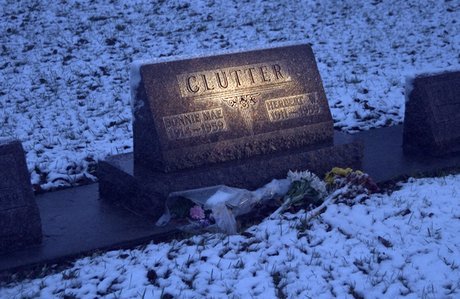
One mid-November night in 1959, four members of the wealthy Clutter family were tied up, shot and killed in their home.  Herb Clutter, a successful rancher, along with his wife and two children Nancy and Kenyon, were found dead the next morning when friends arrived to catch a lift to church.  The book explores how this horrific crime affected the surrounding community, and how the authorities locally and across the US worked tirelessly to catch the culprits.  Alongside events in Kansas, Capote simultaneously offers us the story of the murderers themselves.  Perry Smith and Dick Hickock both had charismatic personalities and complicated back stories, and after the Clutter murders managed to evade the law for over a month and a half before they were finally captured, jailed and taken to trial for their crimes.  They were hanged in April 1965.

So far, so Crimewatch.  What really makes this book special is how much heart and soul Capote pours into it.  His eye for a good story and his focus on people rather than process render In Cold Blood as gripping and enjoyable as a novel.  The amount of painstaking work he must have put into bringing this sweeping story together is genuinely awe-inspiring.  For me, there was also the intriguing fact that Capote was known to have become close to Perry Smith during his research - how much did that skew how he was portrayed?  It was certainly fun to wonder as I was reading. 

Smith and Hickock sit right at the heart of the book, and it is their humanity that provided the most disturbing and thought-provoking aspect of my reading experience.  I found myself reflecting on the complexities of law and order, and the validity of the death penalty.  I began to consider the murderers more closely, to ponder whether one was more guilty than the other and what made them so - their mental health, their level of participation, their attitude?  There were moments where Hickock melted into a normal American boy, and many times where I felt genuine sympathy for Perry and quite liked him - until some little word or gesture reminded me exactly what I was reading and what he had done.

In short, In Cold Blood has everything I want from a book: intriguing characters, an exciting narrative, thought-provoking themes and superb writing.  The fact that the entire book is a work of true crime only adds to its brilliance, because every detail, movement and conversation had to have been so meticulously researched and slotted together to create this perfect piece of storytelling.  I now have the 1967 film adaptation to watch and two more Capote/Hickock/Smith movies to track down (Capote and Infamous) - and In Cold Blood is taking its place as one of my favourite reads of 2012!  Highly recommended.

Notable Quotables:
  • "Imagination... can open any door - turn the key and let terror walk right in.  Tuesday, at dawn, a carload of pheasant hunters from Colorado - strangers, ignorant of the local disaster - were startled by what they saw as they crossed the prairies and passed through Holcomb: windows ablaze, almost every window in almost every house, and, in the brightly lit rooms, fully clothed people, even entire families, who had sat the whole night wide awake, watchful, listening."
  • "'What is life?  It is the flash of a firefly in the night.  It is a breath of a buffalo in the winterime.  It is as the little shadow that runs across the grass and loses itself in the sunset.' - Said by Chief Crowfoot, Blackfoot Indian Chief."


Source:  I borrowed this book from my local library..

Wednesday, 27 June 2012

DOUBLE REVIEW: V for Vendetta, by Alan Moore and David Lloyd (4.5*)


THE BACKGROUND

I've been wanting to read this book for SO LONG - and I've been wanting to watch the movie ever since I discovered the book.  Finally, fairly recently, everything came together!  I found the DVD at a local charity shop for £2, the book came into the library at long last, and by the time I was halfway through it I'd fallen in love and bought my own copy anyway.

The basic summary goes like this:  England is now under the control of a totalitarian government called Norsefire.  The different branches of control - the Eye, the Ears, the Voice and so on - fall under the dictatorial rule of one power-hungry leader.  The story opens on 5 November with Evey Hammond, a young woman, out after curfew and about to be raped by a bunch of corrupt government officers.  To her simultaneous relief and surprise, she is saved by a masked and cloaked figure who rather theatrically recites a section of Macbeth as he effortlessly takes down the agents.  Thus we meet the enigmatic V, and watch as he takes Evey into his confidence and sets in motion his elaborate plan to bring down the government once and for all.  But who is he?  What did they do to him?  Is he a madman, a genius, a terrorist, a freedom fighter - or a mixture of all of these things?

The graphic novel was originally published in the 1980s, but my new edition was published by Titan Books in 2005.  The movie, starring Natalie Portman as Evey and Hugo Weaving as V, came out in 2006 and was directed by James McTeigue and written by The Wachowski Brothers, of The Matrix fame.

THE BOOK

This being my first ever graphic novel, I really wasn't sure what to expect.  I didn't know if I'd fully engage with the visual format, or if I'd be involved enough in the emotional aspects of the novel to really enjoy it.  Which just goes to show how little I know - because it completely blew me away! 

Between Moore and Lloyd they have crafted a beautifully stylised book that was as moving and exciting as any novel could be.  The use of creative techniques like 'voiceover' captions and poignant juxtaposition actually creates an experience that is at times even more powerful than a 'conventional' novel.  The musical interlude, a third of the way through the book, is one of the most poignant and memorable bookish moments I've ever come across - it is sheer genius from start to finish.  Complimenting Moore's writing, Lloyd's artistic style is dramatic, using stark colour contrast and black backgrounds to bring England's bleak existence to life.

There were some elements of the book that differed from the film.  There were more characters, exploring this new society across a wider range of individuals, including the wives and partners of some of the government agents.  The key characters' back stories were also explored in more detail, as you might expect.  It was perhaps easier to follow V's flights of speech and copious literary allusions in print, where they were obviously reduced to the readers' own speed.  In the movie some of his rhetoric is delivered in a furious and unstoppable torrent, so it's easier to miss things along the way.

The symbolism in the book - and film - is one of its strongest points.  I can see now why the Guy Fawkes mask has become such a potent cult emblem over the years.  More than symbolism in itself, I think V for Vendetta is about the POWER of a symbol.  One letter, one mark, one dynamic figurehead - that is all it can take to create an icon, to bring about a revolution.  And alongside the power of symbols, of course, V is a deep believer in the power of the ideas behind them.  The book explores how an idea can flourish and strengthen if you only ACT on it: something we can all take away and apply to our lives, where so many of our hopes and dreams remain just that - ideas.

Notable Quotables:
  • "Everybody is a hero, a lover, a fool, a villain...  Everybody has their story to tell."
  • "Authoritarian societies are like formation skating.  Intricate, mechanically precise and above all, precarious.  Beneath civilisation's fragile crust, cold chaos churns... and there are places where the ice is treacherously thin."
  • "From rubble may we build."

THE MOVIE


The film adaptation of V for Vendetta takes the stylised swirl of Lloyd's images and makes them harder and cleaner.  The theatricality and the most striking images remain, only now they live and breathe and move - which is exactly how a film adaptation should be!  All of the key moments of the book, the most memorable frames, are there, and are reproduced so beautifully on screen that it really is a case of 'bringing the book to life'.  The addition of music strengthens the atmosphere and creates even more layers in V's enigmatic story.  Natalie Portman is on top form as Evey, and casting John Hurt as the High Chancellor is an inspired reversal of his role as 'everyman' Winston Smith in Michael Radford's Nineteen Eighty-Four.

I think one of the key strengths of the film is that it takes a superhero, a character who seems perpetually untouchable, calm and sure of himself, and makes him human.  Although most of his surety and confidence remains, screen V is just that little bit less distant.  He cooks breakfast (V with a dishcloth thrown over his shoulder, cooking eggs?  Priceless!), he is unsure of himself, he gets angry, and if we could see under that smiling mask I'm sure we would have seen a blush or two.  All credit to Hugo Weaving for giving a faceless character such a variety of expression...

There are some changes, of course.  For example, Evey's moment of triumph near the end of the book is changed in such a way that it surely works much better on screen than the original would have done.  The film also redeems those who deserve it, which the book doesn't entirely.  The resulting finale is so powerful that I was holding my breath, tears streaming down my face as I watched it.  The filmmakers have cleared out some of the more confusing or convoluted elements of the book's plot too - some of the sideline characters are gone, and the political environment feels more streamlined and focussed.  In a way, Moore's story may have been made all the more powerful by the clarification allowed by the transition from page to screen.

THE VERDICT

I think V may be one of the most magnetic characters I've ever come across, on the page OR on screen.  He's quite the gentleman, well versed in literature, music, and all the other elements of culture Norsefire has forbidden.  Every frame and every scene he appeared in, I couldn't take my eyes off him.  I think it has something to do with his monochromatic appearance, the clean lines, the efficiency of his vision... like all the best heroes, he cuts an impressive figure, while retaining a certain poetry that renders him irresistable.  His Shadow Gallery is almost as covetable as the Beast's library (don't pretend you didn't want it, ladies!), and his care of Evey and reverance for the beautiful Valerie render him deeply, poignantly human.  He reminded me a little of the Phantom of the Opera in a way, only he kills for justice, not out of bitterness and jealousy.  In fact, he's pretty darn sexy! 

My advice to anyone considering reading their first graphic novel?  Do it.  And if you like masked heroes, political intrigue and gentle romance, this might just be a good place to start.  V for Vendetta offers a wonderfully complex look at the corruption and brutality of a totalitarian government, and its effects on the whole of society, including the families of the people who forms its backbone.  And on a smaller scale, it is the story of one man who is determined to set things right.  He never moans, he never complains, but he knows what must be done and he does it.     

Both the book and the film are absolutely fantastic, but if you're planning to tackle both, I'd definitely recommend reading the book first.  It will give you a stronger understanding of Norsefire and the politics of Evey's world, as well as giving you a good grounding in V's style.  Some of his motives and explosive exploits are more thoroughly explored in the book, and it is obviously easier to follow his literary and ideological flights of rhetoric in print.  Then when you're done reading, you can watch the movie and see Lloyd's illustrations coming to life before your very eyes... 

Enjoy... and England prevails!

Wednesday, 30 May 2012

REVIEW: Rant - An Oral Biography of Buster Casey, by Chuck Palahniuk (4.5*)

(Vintage, 2008)

I've never read Palahniuk before, and although everyone raves about Fight Club, in particular, I wasn't really sure his famously oddball style would be 'my kind of thing'.  Happily, Rant turned out to be EXACTLY my kind of thing, which is why this review has taken so long to write.  It's always hardest to review the books we've loved most, isn't it?

I won't say too much about the plot, partly because there isn't one per se, and partly because I think this is really one those books that needs to be read WITHOUT knowing everything about it.  That way the reader can work things out for themselves and be swept along by the narrative without any preconceptions and erroneous ideas ruining the fun.  On the surface this is just what the name suggests: a fictional oral biography of a strange young man called Rant Casey, who has odd abilities, bizarre habits, and dangerous vices that include 'Party Crashing' - driving around at night in a kind of giant crazy game of dodgems - and being bitten by all kinds of venomous and diseased creatures.

But although Rant is at the centre of the novel, and everything ultimately returns to him, this is an incredibly reductive view of Palahniuk's vision.  It is also very much about the way society works and about the people in Rant's life over the years.  It is only as the book unfolds that you come to realise that Rant's America isn't the same as ours; it's a futuristic place with advanced media technology, and a society segregated into Daytimers and Nighttimers in an attempt to deal with overpopulation and road congestion.  As these things are explained by the various 'contributors' to Rant's biography, the book becomes almost like a fascinating non-fiction at times, kept manageable and well-paced by the broken-up oral-biography format. 

This really is an incredible book.  It has the energy of a Baz Lurhmann movie and the no-nonsense brutality of Quentin Tarantino's finest, all rolled into one.  I don't think I've ever read a book that feels so immediate and ALIVE.  It bristles with energy, like electricity sparking off the page.  As I turned the pages, I felt like I was in the hands of an expert manipulator; the building clues about Rant, about the new society, were all there, but I felt like I was working things out and getting little light-bulb moments EXACTLY when Palahniuk wanted me to.  Whatever he wanted me to feel - nauseated, tender, intrigued, repulsed - I did.  Even when I wasn't sure what was happening or where things were going, I felt 'safe' enough to accept it and carry on.  Like the Nighttimers' Party Crashing culture, I just held on tight and went along for the ride - and what a ride it was!

Rant definitely isn't going to be for everyone - there are some pretty extreme and unsettling moments thrown in along the way - but if you dare to dive in and go with it, you will find a novel that is simultaneously philosophical, amusing, disgusting, exciting, thoughtful, sensual, perplexing, shocking, stimulating and utterly brilliant.  Palahniuk throws out a continuous stream of ideas and observations, skewed through the different characters that make up the 'biography' and through the vaguely dystopian perspective.  I'm still thinking about it now, a couple of weeks later, asking questions and trying to work it out in my mind all over again.  Needless to say, I won't hesitate to read more Palahniuk now I've started.

Notable Quotables:
  • "The way Rant Casey used to say it: Folks build a reputation by attacking you while you're alive - or praising you after you ain't." - Wallace Boyer
  • "In the first forty-three seconds you meet a stranger, experts in human behaviour say that, just by looking at them, you decide their income, their age, their brains, and if you're going to respect them." - Wallace Boyer
  • "How weird is that?  A sexually conflicted thirteen-year-old rattlesnake-venom junkie with rabies - well, it's safe to say that's every father's worst nightmare." - Shot Dunyan
  • "It doesn't matter for crap that you've got three years of sobriety or that you finally look good in a two-piece bathing suit or you've met that perfect someone and you've fallen deeply, wildly, passionately in love.  Today, as you pick up your dry cleaning, fax those reports, fold your laundry, or wash the dinner dishes, something you'd never expect is already stalking you...  That bullet or drunk driver or tumor with your name on it, the way I tolerate that fact is by Party Crashing.  Here's one night when I control the chaos.  I participate with the doom I can't control.  I'm dancing with the inevitable, and I survive.  My regular little dress rehearsal." - Shot Dunyan
  • "There's worse ways to be dead than dying." - Shot Dunyan
  • "Every high school has its Romeo and Juliet, one tragic couple.  So does every generation." - Toni Wiedlin
  • "You could argue that we constantly change the past...  I close my eyes, and the Rant Casey I picture isn't the real person.  The Rant I tell you about is filtered and colored and distorted through me." - Shot Dunyan
  • "Ask yourself: What did I eat for breakfast today?  What did I eat for dinner last night?  You see how fast reality fades away?" - Neddy Nelson

Source: I borrowed this book from my local library. 

Monday, 14 May 2012

What I Love About Read-a-Thons, by Ellie aged 24 3/4

1.  There Will Be Pizza
And other delicious snacks.  Read-a-thons are all about luxuriating in reading pleasure, and as we all know, what we're shoving in our mouths as we turn the pages is a huge part of that.  Some people prefer to go for vegetables and dips and healthy, healthy food - but let's face it, that really isn't my style.  For me, the ideal read-a-thon food is anything I can cook quickly and/or graze on.  That means stuff I can cook, slice up and nibble (pizza, Spanish tortilla); stuff I can toast (pancakes, toasted teacakes and, er, toast); cakes and pastries (chocolate chip muffins and custard Danish pastries being my vices of choice) and stuff I can pour into a bowl (sweet popcorn, Hula hoops, M'n'Ms)... I think I might have put on three stone just writing this paragraph.


2. Read-a-Thons are a Geek's Paradise
NO WORD OF A LIE.  There are SO MANY opportunities to geek out during a read-a-thon, which is probably why I love them so much.  Before every read-a-thon I have a total list-making frenzy, combing through my LibraryThing catalogue hunting down potential reads.  It stops me overlooking any perfect candidates and sometimes I stumble across a book and get that NOW IS YOUR TIME feeling.  Aside from all the list-making, a read-a-thonner also has the opportunity to keep numerous read-a-thonny statistics (page numbers, hours, books) to his or her own level of nerd-compulsion.


3. Snoozing Is Compulsory
Whether you're doing a 24-hourer or a seven-dayer, it is VITAL that you get some snoozing time in there somewhere.  Obviously, if you're reading for seven days you're going to be, y'know, SLEEPING and all that.  But if you're reading for any prolonged amount of time, day or night, you know that at some point your eyes will start to burn, the words on the page will start to swim, you'll read the same paragraph thirty times, and suddenly the cushion/sofa/bed/floor will look sooooo inviting...  That's when you snooze.  Twenty minutes later, you wake up, pop a handful of M'n'Ms, and the read-a-thon goes on!


4.  Step Away from the Interwebs
This is v. ironic because quite often during readathons I end up spending a ton of time online reading (and writing) stuff ABOUT said readathon.  I suspect I am not the only one.  WHAT ARE YOU DOING HERE READING THIS RIGHT NOW, HMMMM?  I thought so...  The bestest thing about read-a-thonning is that it is a most excellent excuse to NOT do other stuff, like laundry, gardening, cleaning, shopping and playing on Twitter.  Okay, there might be a bit of playing on Twitter.  And laundry.  But the read-a-thon is a very good reason to keep these dangerous, dangerous things in moderation and retreat somewhere cosy where you can read and eat biscuits instead.


5.  I Did it Myyyyyy Waaaaaaay
Above all, a read-a-thon should be FUN!  Whether you're reading over breakfast or before bed, at work or in the park, sunbathing in the garden or huddled in an armchair watching the rain, for twenty minutes at lunchtime or twenty-four hours on your day off, it's all about doing it your way.  Everything about your read-a-thon is personal and interesting, which is why I love trawling other people's updates!  I want to know that X is reading Sarah Waters in Edinburgh, eating Nutella with a spoon, while Y is in Florida reading Charles Dickens while their homemade lasagne cooks and Z is sitting on a bench on their university campus drinking chai latte and reading Sarah Dessen.  This is what it's all about!  Reading good books, eating good food, making good friends and being really, REALLY nosy about other people's reading habits.


Happy reading, everyone!

Friday, 4 May 2012

REVIEW: King Solomon's Mines, by H. Rider Haggard (5*)

REVIEW: KING SOLOMON'S MINES (5*)

by H. Rider Haggard (Penguin Popular Classics, 1994)

Well, here's a rave review I didn't expect to be writing!  In fact, I'm not even sure I'm going to make this into a 'real' review - how do you review a book that's been read by generations already and been discussed hundreds of times to boot?  I think if I have to attempt that I might never post ANYTHING about it, so I thought I'd go for a rambly collection of thoughts instead.  Better that nothing, right?!

** There may be teeny tiny SPOILERS ahead here - it's hard to throw together all my thoughts about the book without revealing any details!  But I'll try to keep them very mild and not reveal any major plot points and big moments, okay?  Read on! **

I borrowed this book off my sister's shelves, expecting a light, dated and slightly rubbish adventure story, something I could read fairly quickly, tick off my list, and stick back on the shelf without any fuss.  I am happy to report that I couldn't have been more wrong!  I LOVE it when this happens - when I'm not expecting much from a book and it turns out to be awesome.  Makes the pleasure that much more satisfying, don't you think?  Actually King Solomon's Mines completely blew me away, and by the end, to my surprise, it had even managed to topple Eowyn Ivey's The Snow Child off the top spot as my favourite book of 2012 so far.

In a nutshell, this is a proper old-fashioned adventure yarn.  It is narrated by the now-iconic Allan Quatermain, an English hunter making his living shooting game in South Africa.  He is on a boat returning to his home in Durban when he meets Sir Henry Curtis and his friend, naval officer Captain John Good.  Sir Henry is attempting to find his brother, last seen heading out on a suicidal mission across the desert in search of King Solomon's legendary diamond mines.  He enlists Quatermain's (rather reluctant) help and the three set out for the mountains, aided by a crudely-drawn map left to Quatermain by the last fool to attempt the journey.

What follows is a real Indiana Jones story that had me completely absorbed from start to finish.  First the desert must be navigated, then there are mountains to cross, only for the exhausted trio to find themselves embroiled in a bitter tribal war on the other side.  It could have been so dull, but Quatermain's plentiful dry humour and beautiful flights of description proved irresistable.  The excitement and suspense is genuinely riveting - there are a couple of deliciously gruesome moments that sent me mentally diving behind my sofa cushion - and when I reached the last page I felt utterly bereft.  Having been so completely immersed in the trio's African exploits, I wasn't quite sure what I could read next that could POSSIBLY compare (always the sign of a great book!).

I think two things really made it for me: the characters and the big set-piece moments.  The characters are exquisite creations, each and every one of them.  Sir Henry, the great fair Viking with his deep integrity and ferocious strength as a warrior.  Captain Good, with his eye glass, impressive swearing abilities (never rendered here, by the way!) and determination to dress like a gentleman despite the harsh conditions.  Even foul old Gagool, the ancient and evil Kukuana witch doctress, was so brilliantly drawn that I felt a wave of revulsion every time she graced the page with her presence.

One thing that pleasantly surprised me was the respect Haggard shows towards other races - I had expected a more 'savages vs whites' mentality.  In some ways it is still very much of its time, of course - for example, the idea that it wouldn't be 'proper' for a black person and a white person to be together, and the implication that the local tribes are inferior in status and intelligence - but in others it seems quite progressive.  Quatermain and his companions show great affection and respect for the Kukuana tribespeople across the mountains, joining their civil war and becoming close friends with several of their leaders.  These leaders are portrayed as impressive, if brutal, warriors, and honest men.  The Kukuana language is wonderful too, 'translated' by Quatermain in all of its grand, sweeping and eloquent beauty.

The biggest thing I'll take away from the book, the element that will stick with me the most, is the incredible set-piece imagery, some of which wouldn't seem out of place in a Lord of the Rings film.  I think certain 'snapshots' from the book are forever imprinted on my memory, they're so unforgettable.  The great twin mountain peaks at sunrise.  A wounded bull elephant charging through the trees (there are scenes of elephant hunting in the book, by the way, but as with the outdated race issues it would be unfair to judge Haggard too harshly for it).  Key moments from the tribal war.  The moment when the trio first enter the Kukuana Place of Death (that was perhaps the most memorable scene of all for me).  I mean... wow.  I'm actually glad that no decent film adaptation of the book has ever been made, because now I'm not tempted to watch it.  It'd take a damn fine movie to match up to the pictures in my mind!  Perhaps I should write to Peter Jackson...

Notable Quotables:
  • "There is no journey upon this earth that a man may not make if he sets his heart to it.  There is nothing, Umbopa, that he cannot do, there are no mountains he may not climb, there are no deserts he cannot cross... if love leads him and he holds his life in his hand counting it as nothing, ready to keep it or lose it as Heaven may order."
  • "On, on we went, till at last the east began to blush like the cheek of a girl.  Then there came faint rays of primrose light, that changed presently to gold bars, through which the dawn glided out across the desert.  The stars grew pale and paler still till at last they vanished; the golden moon waxed wan, and her mountain ridges stood out against her sickly face like the bones on the cheek of a dying man.  Then came spear upon spear of light flashing far away across the boundless wilderness, piercing and firing the veils of mist, till the desert was draped in a tremulous golden glow, and it was day." - Isn't that just gorgeous?
  • "My mind's eye singled out those who were sealed to slaughter, and there rushed in upon my heart a great sense of the mystery of human life, and an overwhelming sorrow at its futility and sadness...  Only the old moon would shine on serenely, the night wind would stir the grasses, and the wide earth would take its rest, even as it did æons before we were, and will do Ã¦ons after we have been forgotten."
  • "Reader, you may have lain awake at night and thought the silence oppressive, but I say with confidence that you can have no idea what a vivid, tangible thing is perfect silence.  On the surface of the earth there is always some sound or motion, and though it may in itself be imperceptible, yet it deadens the sharp edge of absolute silence.  But here there was none."
  • "Truly wealth, which men spend their lives in acquiring, is a valueless thing at the last." - Wise words indeed!

Source: I borrowed this book from my sister - though I'll definitely be getting my own copy now I know how flippin' AWESOME it is!

Saturday, 10 March 2012

REVIEW: The Sisters Brothers, by Patrick deWitt (4*)

(Granta Books, 2011)

'You have never thought about quitting?'
'Every man that has ever held a position has thought about quitting.'

Okay, first up let me say that I would never normally have picked this novel up.  Then I saw the folks on the TV Book Club gushing over it, proclaiming that it was perhaps their favourite book from their entire run and that it was a complete surprise - so I picked it up anyway.  And I'm SO glad I did, because they were right - it WAS a complete surprise.  Who would have thought that a western noir about a pair of assassins would have buried its way under my skin so completely?

The book follows the fortunes of the notorious Sisters brothers, Eli and Charlie, as they set out on their latest job - to kill a man called Hermann Kermit Warm, on the orders of their boss, known only as The Commodore.  Set against the California Gold Rush of the mid-19th century, their mission takes them from Oregon City to San Francisco and beyond, in search of the elusive Warm and his claim.  Along the way they drink, flirt and fight with all kinds of weird and wonderful folks, from prospectors to prostitutes.  It's quite a ride, for the brothers and the reader alike!

The most important thing about the novel, and its main draw, is that it is entirely narrated by Eli Sisters - and what a narrator he is!  I've never come across a cold-blooded killer I could really get behind in a book, but Eli was endearing, even loveable, from start to finish!  His narration is spare, thoughtful, poetic, uncompromising, yet strangely innocent, almost childlike at times, and very amusing.  That was one of the biggest surprises about the book - that it is so funny!  The author has really given us a supremely human story in the most unlikely of settings - underneath the casual brutality this is a book about two brothers making their way in the world together, laughing, teasing, arguing and reconciling as they go.  On this journey Eli is also questioning everything about his life: Will he ever be loved?  What has been he missing while he's been under the Commodore's command?  How is he different from Charlie?  Does he want to be an assassin any more or is there a better future out there for him?  He is no faceless killer, he is a man, with morals and a soft spot for his horse and a deep thread of kindness and generosity.  A intriguing protagonist, indeed.

Aside from his wonderful cast of characters, de Witt also offers us a fascinating insight into life in the American West during the Gold Rush.  It is a brutal and lawless place, and he dunks his readers straight in there headfirst so we can almost taste the dirt, smell the cold metal of the brothers' pistols, hear the raucous laughter coming from the saloons...  It was a time when men let their guns do the talking, gold fever swept across America, and San Francisco regularly burnt to the ground and had to be rebuilt as it struggled to cope with the influx of people hoping to make their fortunes from the nearby rivers.  Through Eli, deWitt shows us 19th century California in all her terrible glory, and it is hard to tear yourself away from the pages once you've immersed yourself.

I'd absolutely recommend this book, to men and women alike.  There were moments that made me laugh, moments that made me well up, moments that made my heart sink and moments that made my eyes go wide... and I loved every last one of them.  Eli might end up being one of my favourite characters of 2012 - he's such an unlikely and unusual hero - and his journey was exciting, compelling and pretty darn unforgettable.  Put aside your feelings about westerns, about violence, about historical fiction, about Man Booker nominees, whatever's stopping you picking this book up, and just read it already!

Notable Quotables:
  • "I sat on the bank and watched him splashing and singing; he had not had anything to drink the night before and there had been no other people around to upset his volatile nature, and I found myself becoming sentimental by this rare show of innocent happiness.  Charlie had often been glad and singing as a younger man, before we took up with the Commodore, when he became guarded and hard, so it was sad in a way to watch him frolic in that shimmering river, with the tall snowy mountains walling us in."
  • "'Each job is different.  Some I have seen as singular escapades.  Others have been like a hell.' I shrugged.  'You put a wage behind something, it gives the act a sort of respectability.  In a way, I suppose it feels significant to have something as large as a man's life entrusted to me.'  'A man's death', she corrected."
  • "'All you will get from me is Death.'  Charlie's words, spoken just as casual as a man describing the weather, brought the hair on my neck up and my hands began to pulse and throb.  He is wonderful in situations like this, clear minded and without a trace of fear.  He had always been this way, and though I had seen it many times, every time I did I felt an admiration for him."
  • "I was thinking that a man like myself, after suffering such a blow as you men have struck on this day, has two distinct paths he might travel in his life.  He might walk out into the world with a wounded heart, intent on sharing his mad hatred with every person he passes; or, he might start out anew with an empty heart, and he should take care to fill it up with only proud things from then on, so as to nourish his desolate mind-set and cultivate something positive anew."

Source: I borrowed this book from my local library.

Monday, 13 February 2012

REVIEW: Loaded, by Christos Tsiolkas (3.5*)

(Vintage, 2011)

I wasn't quite sure what to expect from this little book, having read such mixed reviews of Tsiolkas's better-known novel The Slap.  But this one - his first, and pretty short at 151 pages - sounded right up my street, so I thought I'd give it a go!

I was actually very pleasantly surprised.  It is an almost stream-of-consciousness narrative from the fascinating mind of Ari, a nineteen year-old gay Greek boy living in Melbourne.  Ari is simultaneously an aggressively confident young man, and completely conflicted about everything, veering between vehement certainty and utter helplessness.  He isn't entirely at ease with his sexuality, his friends come and go around him, he despises the confinement of traditional Greek life, and he has absolutely no sense of where he's going - despite his occasional protestations to the contrary.  All he really knows is that he loves movies and music, sex and drugs, and that being loaded keeps him calm, quiet and almost content.  The novel drags the reader along for a 24-hour ride inside his head as he snorts, shags, drinks and meanders his way through another day.

A few times as I was reading I found myself thinking, "Wow, THIS is what I wanted when I read Catcher in the Rye!"  I didn't identify with Salinger's whiny Holden Caulfield at all, but I rather liked Ari.  His voice is angry, passionate, intelligent and provocative, and even when I didn't agree with him I couldn't help but feel a admiring respect for his brutal arguments and perceptive observations.  I think as a character, he is so interesting because he can so readily see the beauty of other people and places and situations, yet seems to be incapable of translating that beauty into his own life and future.  I really felt for him!

Despite all this, I didn't give Loaded a higher rating, because although I was completely absorbed in Ari's world, it was quite slow going (perhaps surprisingly, given that Ari is sky high for half of it) and I don't think it will ultimately be a particularly memorable read.  There were one or two moments that really made me cringe, particularly the scenes in various clubs around Melbourne which invariably contain awful descriptions of dancing - frequent mentions of 'jumping around', and what moves Ari's 'working in' from his dance repertoire.  I found these parts incredibly jarring - though perhaps Tsiolkas intended them to be that way, to reflect the way Ari's drugged mind made some unnaturally slow and conscious decisions about even the most mundane of things?  Who knows - all I know is, I didn't like it much.

At any rate, Ari was a wonderful guide to the seedier underbelly of Melbourne life - the dark alleys for fumbling liaisons, the tangled, insular existence of the many different ethnicities on the outskirts of 'skip' society - and I liked the novel enough to give The Slap a try at some point.  I also ordered the screen adaptation, Head On, which I'm rather looking forward to.  Recommended for those who don't mind their literature buzzing, explicit and occasionally a little uncomfortable, even as it forces them to stop and think about the world from a new perspective. 

Notable Quotables:
  • "In the three minutes it takes the song to play I'm caught in a magic world of harmony and joy, a truly ecstatic joy, where the aching longing to be somewhere else, out of this city, out of this country, out of this body and out of this life, is kept at bay.  I relive those three minutes again and again till I'm calm enough to walk back into life again."
  • "They'll tell you God is dead but, man, they still want you to have a purpose.  They'll point to a child and say there it is, that's purpose, that's meaning.  That's bullshit.  A child is a mass of cells and tissues and muscle that will grow up and will become Jack the Ripper or the president of the world.  Maybe.  More likely it will grow up and become a dole statistic.  Worse, it will grow up and become an accountant."

Source: I bought this book from Amazon UK, I think?

Thursday, 5 January 2012

REVIEW: Direct Red - A Surgeon's Story, by Gabriel Weston (4*)

(Vintage, 2010)

I picked this up on a whim, out of a bag of incoming books at the shop, because I've rather enjoyed other 'medical memoirs' I've read in the past.  I find them fascinating, perhaps because the medical profession is such a world apart - men and women caring for every kind of person in every kind of difficult situation, often at absolutely critical moments in their lives.  Gabriel Weston's surgical memoir is definitely the best of the bunch so far, and I can see why it was longlisted for the Guardian First Book Award in 2009.

Weston is a surgeon in a big-city English hospital.  Her book is divided into short, deftly-titled chapters, providing themes for her anecdotes and creating an interesting structure.  'Speed', for example, illustrates the importance of quick thinking and rapid action in saving lives; 'Hierarchy' delves into the power relations of a surgical ward, and 'Children' covers her time in the paediatric emergency room and children's department.  Theming each section allows Weston to move around in time and to make important points about the surgical profession without muddling her narrative, and it really worked for me.

This is a beautifully written book that rings with the precise and matter-of-fact detail that a surgeon's eye is trained to notice.  Weston's disclaimer points out that no one character or situation here is 'true' - but I don't think it really matters, because at the book's heart is a thoroughly authentic and experienced voice.  There were some heartbreaking moments and some charming ones, some lyrical descriptions and some blisteringly earthy ones.  Far from being frightened by the graphic surgical scenes, I found myself reassured by how much the human body can withstand, and how much a surgical team can do to mend it when it is broken.  Highly recommended - though if you're squeamish you should probably give this one a miss!

Source: I borrowed this book from our bookshop shelves.

Friday, 9 December 2011

REVIEW: Atonement, by Ian McEwan (4.5*)

(Vintage, 2007)

Wow, what a book!  Yet another novel that has stayed on my shelves for far too long, partially because I was so intimidated by it and partially because of all the hype surrounding it a few years ago.  As it turns out, I needn't have worried on either of those counts.  It wasn't a difficult read at all, and the hype was entirely justified!

At its barest of bones, this is a book about two lovers and the girl who tears them apart.  Cecilia Tallis, a rich young woman, and Robbie Turner, her charlady's son, have both recently returned to the Tallis estate from Cambridge University, where they have been studiously avoiding one another.  It is only during the hot summer following their return that they realise how deep their feelings really are.

Waiting for them back home is Cecilia's younger sister.  I have to admit, I hated Briony in the first half of the book.  She reminded me of a young version of Barbara in Notes on a Scandal.  Manipulative, naive, attention-seeking, self-obsessed and utterly destructive in her unswerving self-righteousness.  Briony wants to be a writer and a grown-up, not necessarily in that order, and her imagination tends to run away with her.  When a collection of bizarre encounters and Briony's overactive mind are thrown together during one frightening night, Robbie is arrested for a crime he didn't commit, and the Tallis family falls apart.

Moving on a few years, Robbie is fighting his way across France in a desperate attempt to get back to Cecilia; the love of his life is pouring out her devotion in her letters, waiting for him to return, and Briony is seeking to redeem herself by following in Cecilia's footsteps and training as a nurse.  From the innocence and family atmosphere of the first half of the book, suddenly the reader is plunged into Robbie's terrifying trek towards the beaches of Dunkirk, and from there into Briony's horrific experiences in the hospital as the first soldiers are brought back from the retreat.  Will Cecilia and Robbie be reunited?  And will Briony ever manage to atone for what she did and finally set things to rights?

I cannot believe how much I underestimated this book.  McEwan's writing is simply sublime.  He keeps the pace steady, picking out tiny details and observations, exploring personal motives and flights of fancy, revisiting memories, and immersing the reader completely inside his characters' heads - yet I never felt impatient for things to speed up.  It would have been so easy for chaotic moments in France and in the hospital to be flitted over and churned together into a frenzy, but their impact would have been halved.  There is no escape from the thoughts, the joys, the horrors, the beautiful and haunting things that McEwan wants us to see.  With a single sentence he can rip the rug out from under the complacent reader, then with a beautiful description encourage us to regroup and reflect once more.  As with so many books in which I become deeply attached to and emotionally invested in each and every character, I had a feeling I was going to be a bit tearful by the end, and I was right - I spent fifteen minutes sobbing into my pillow!

I could go on and on, but instead I'll stop here and just say... please read it.  You will recognise yourself in parts, and recoil from others; you will be educated and shocked; you will feel elation and joy but also be plunged into sadness and anger.  It is an epic and exquisite rollercoaster, and I am so glad I finally chose to stop procrastinating and experience it for myself!

Source: I bought this book from a charity shop.

Monday, 14 November 2011

REVIEW: Percy Jackson and the Lightning Thief, by Rick Riordan (4*)

(Puffin, 2008)

Life is about to get very interesting for Percy Jackson.  Slightly unusual things have been happening to him his whole life, but when he accidentally vaporises his maths teacher during a school trip, it becomes apparent that something much bigger is afoot.  Within a matter of days he has arrived at Camp Half-Blood, met a god, discovered that his best friend is a satyr and his father is Poseidon, and been accused of stealing Zeus's master lightning bolt.  Can he find the bolt and return it to Olympus before the gods turn on each other and ignite a cataclysmic world war?

It's really a very clever premise, and one that would have completely swept me away as a younger teenager.  I'd have been in the library poring over books on the Ancient Greek gods before you could say Apollo.  Now, in my mid-twenties, it was a really fun way to brush up on some of the myths and legends I used to know - and I'm probably more likely to remember who's who on Olympus after reading Percy Jackson than if I'd read a textbook instead!

The story roars along at a cracking pace, with lots of exciting action and adventure and some hilarious little touches - like Cerberus, the three-headed canine guardian of Hell, playing catch with a red rubber ball, which made me smile.  Riordan mixes the modern world with the mythology of the Greek gods beautifully, bringing them right up to date while maintaining their dignity and all-powerful other-worldliness.  I loved it - and needless to say, I'll be reading on with this series very soon!

Source: I think I bought this book from Amazon UK?

Saturday, 5 November 2011

REVIEW: Faceless Killers, by Henning Mankell (4.5*)

(Vintage, 2002)

I'd already come across Kurt Wallander thanks to the excellent Kenneth Branagh series, but this is the first time I've picked up one of the original novels.  Happily, I liked it so much that I'm all ready to go on a rampage and buy the rest of the books AND the two television series.  I love it when that happens!

The novel opens with the discovery of a horrific murder in the isolated farming community of Lunnarp.  Called in by a terrified neighbour, Inspector Wallander arrives to find a mutilated and bloodied old man dead in his farmhouse bedroom.  His wife is alive, but only barely, with a noose cruelly knotted around her neck.  Armed with a host of confusing clues, uneasy hunches and the word 'foreign', repeated by the old woman on her deathbed, Wallander and his team must pull out all the stops to find the killers before the media storm around the case sparks a national wave of racial hate crime.

I found the whole novel absolutely fascinating, and it was a great brain work-out.  I couldn't stop mulling over everything that had happened so far, and every time I put the book down I was itching to get back to it again!  I think it helps that the reader is basically inside Kurt Wallander's mind from start to finish, even though it's written in the third person.  He's a thoughtful, clever, kind and immensely human character, with a fierce sense of justice and a touch of quiet vulnerability - the kind of cop every reader will be rooting for!  I also liked that this was very much a procedural novel, rather than a forensic gorefest, and the way the Swedish setting really came to life on the page.  Mr Mankell - you have another new convert!  Highly recommended.

Source: I think I found this book in a charity shop?  Maybe?  

Sunday, 11 September 2011

REVIEW: The Princess Bride, by William Goldman (4.5*)

(Bloomsbury, 1999)

Like many people I expect, I came to this book having already seen and loved the 1987 movie – a fact that is beautifully exploited by Goldman in this up-to-date edition of his cult classic. From the first page of his tongue-in-cheek introduction I found myself stifling giggles, reading about the process of casting and shooting the film. It was once the novel itself began, however, that I really fell in love.

As most people will know, The Princess Bride is a satirical take on fairytale tradition, ‘abridged’ from a larger fictional work by ‘S. Morgenstern’. One of the real delights in the book is how convincing Goldman is about the existence of the fictional country of Florin and about Morgenstern’s style as a writer. There are brilliantly executed editorial sections scattered throughout the novel detailing his decisions to cut various parts of the ‘original’. It really is no wonder that so many readers hit the bookshops looking for Morgenstern’s version!

The story itself is famous for its brilliant wit and its cast of wonderful characters. At its heart is the story of the Princess Buttercup and her true love, the farm boy Westley. Around that heart is built a complex web involving pirates, sword-fights, an evil prince, a benevolent king, revenge, monsters and betrayal. There is a Zoo of Death and a terrifying Dread Pirate Roberts, an albino and a miracle man, giant rats and Cliffs of Insanity. Of course, I couldn’t forget the wonderful trio, Vizzini the Sicilian (the criminal mastermind), Inigo the Spaniard (the master fencer) and Fezzik the Giant (the rhyming fighter), each with their own journeys to make.

I could go on forever but the truth is, it’s really one of those books that works better if you just pick it up, settle in for the ride and find out for yourself. If you’ve seen the movie, now read the book; if you’ve not heard of either, what are you waiting for?! You’re in for a real treat – and it’s definitely a keeper for me.

Source: I bought this book from Scarthin Books in Cromford.