Monday, 19 November 2012

Bookish Epiphany Part 2: Devolution by numbers

Yesterday I posted Part 1 of this rather epic exploration of my dissatisfaction with my current relationship with books, as well as with other media that I use on a daily basis - namely, television and the bottomless rabbit hole that is the internet.  I talked about the way my ability to prioritise seems to fail me completely so that I miss out on a lot of the stuff I really used to appreciate, instead spending hours watching the same old telly and messing about online.

In Part 2 I want to delve further into the way my reading habits have changed.  For a while I have been using the collections feature on LibraryThing to add each book I read to a collection for the year (Read in 2011, Read in 2012, etc), but have never actually gone back and looked at them in much detail before.  Until this week my only real interaction with these little reading microcosms has been to idly scroll through them and vaguely feel that some of my previous years' collections contain far more interesting and memorable books than those from the most recent years.  Crunching the numbers over the past few days, looking more closely, I've learned a few startling home truths about my reading habits, which illustrate pretty clearly why my relationship with my reading has gone downhill over the past year or two...

So, here we go.  I started making some kind of record of my reading mid-2006, so that's where we'll start.  I've included university texts where I read them in their entirety (eg. some classic novels) but not if I just used them briefly (eg. for essay research), because there'd be too many to count.  I've classed 'YA and Children's Books' as a genre, simply because I tend to read YA fiction as a break from adult novels and so splitting them up would be beside the point.  The only exceptions to this rule are books like The Wizard of Oz and A Little Princess, which I've counted as classics. 

This may be the most boring post EVER, and if that's the case I do apologise, but I'll be honest... I'm laying this out as much for my own benefit as I am for entertainment value, so just run with it, okay?  Think of it as a chance to get to know me better, and have fun ringing the differences between the statistics here and what I've been reading and reviewing so far this year.  :)

2006 (23 books) 
Male authors: 12 / Female authors: 11
'Serious' books: 14 / 'Fluffy' books: 9
Adult books: 23 / YA and Children's books: 0
Fiction books: 7 / Non-fiction books: 16
By genre
Literary fiction: 5
Miscellaneous non-fiction: 5
Social sciences: 3
Humour: 3
(Auto)Biography: 2
Classics and Poetry:
Travel writing: 1
History: 1
Chick lit: 1
Notes
2006 covered two thirds of my first year at university, and the first semester of my second year.  I read Between the Acts and The Waste Land for my course, and a book on flamenco from the library out of pure interest.  'Books about books' came in the form of Ex Libris and A Book Addict's Treasury, and I also ventured into literary fiction and the social sciences.  I alternated between reading fiction and non-fiction, supplementing heavier classics and ethical manifestos with gripping page-turners and humorous non-fiction.
Highlights
The Shadow of the Wind (Carlos Ruiz Zafón), A Book Addict's Treasury (Julie Rugg and Lynda Murphy), No Logo: Taking Aim at the Brand Bullies (Naomi Klein), The Highest Tide (Jim Lynch), Ex Libris (Anne Fadiman), Neither Here Nor There (Bill Bryson)
2007 (42 books)
Male authors: 20 / Female authors: 22
'Serious' books: 20 / 'Fluffy' books: 22
Adult books: 35 / YA and Children's books: 7
Fiction books: 15 / Non-fiction books: 27
By genre
Social sciences: 9
(Auto)Biography: 8
YA and Children's: 7
Chick lit: 4
Classics: 3
Travel: 3
Humour: 3
History: 2
Miscellaneous non-fiction: 2
Literary fiction: 1
Notes
Most of 2007 was spent at university, but actually, simultaneously not there.  A rather hideous depressive episode in the last semester of 2006 meant that I took the decision to spend the rest of the academic year away from my course, resuming my studies in September.   Despite this, I still lived in my uni house, worked locally to make up for my halted student loan, and still had all the perks of a student - like a university library card.  I read tons of non-fiction for pleasure, including lots of social science books (mostly on consumer behaviour and children's welfare), a rather obscure 'biography' of Saint Nicholas and the evolution of the Santa figure, Che Guevara's The Motorcycle Diaries, and a potted history of Eton.  This was also the year of the 'all seven Harry Potter novels' marathon, the year I first read the life-changing Books, Baguettes and Bedbugs, the year I finally reread Wuthering Heights, AND the year I discovered that Nicholas Sparks could make me cry even if I already knew the sad part.  In short, this was a great reading year.  One of the two I look back on and think 'yeah, that was the stuff'. 
Highlights
Shopped: The Shocking Power of British Supermarkets (Joanna Blythman), Wuthering Heights (Emily Brontë), The Story of Childhood: Growing Up in Modern Britain (Libby Brooks), Rebecca (Daphne du Maurier), Books, Baguettes and Bedbugs: The Left Bank World of Shakespeare and Co. (Jeremy Mercer), Hunger: An Unnatural History (Sharman Apt Russell), The Notebook (Nicholas Sparks), Shop 'Til You Drop: Consumer Behaviour and American Culture (Arthur Asa Berger - the chart comparing shopping malls to cathedrals and shopping to religion was particularly memorable)
2008 (42 books)
Male authors: 21 / Female authors: 21
'Serious' books: 26 / 'Fluffy' books: 16
Adult books: 36 / YA and Children's books: 6
Fiction books: 21 / Non-fiction books: 21
By genre
Literary fiction: 9
Social sciences: 6
YA and Children's: 6
(Auto)Biography: 4
Humour: 4
Miscellaneous non-fiction: 4
History: 3
Chick lit: 3
Classics: 2
Sci-fi, Fantasy and Horror: 1
Notes
2008 was a very... equal... year in terms of fiction and non-fiction, and male and female authors, leaning towards literary fiction and in-depth non-fiction.  This was the year I was at home, pretty much housebound, thanks to the onset of my agoraphobia.  Many of my favourite books of the year actually came courtesy of a couple of all-out trips to the big library in the next town, where I upheld my university love of taking a chance on all kinds of non-fiction in my quest to learn more about the world.  I read books on Ancient Egypt and Shakespeare, more social science books, and finally picked up A Christmas Carol on Christmas Eve.  I discovered Alice Hoffman and Alan Hollinghurst, and reread childhood favourites Matilda and A Little Princess.  This was also the year Twilight hit our shelves (and screens), so I swallowed that whole as well!  This was the second of my two great reading years, I reckon, because I made the time to do what I love best - learn new things and devour great novels.  This, then, was the pinnacle of my reading pleasure. 
Highlights
A Christmas Carol (Charles Dickens), Opening Skinner's Box: Great Psychological Experiments of the Twentieth Century (Lauren Slater), The Swimming-Pool Library (Alan Hollinghurst), The Ice Queen (Alice Hoffman), Snoop: What Your Stuff Says About You (Samuel Gosling), Tutankhamen: Life and Death of a Pharaoh (Christiane Desroches-Noblecourt), Nefertiti (Michelle Moran), Queuing for Beginners: The Story of Daily Life from Breakfast to Bedtime (Joe Moran), The Plug-In Drug: Television, Computers and Family Life (Marie Winn), Good Omens (Terry Pratchett and Neil Gaiman), This Book Will Save Your Life (A.M. Homes), Year of Wonders (Geraldine Brooks), The Uncommon Reader (Alan Bennett)


2009 (55 books)
Male authors: 28 / Female authors: 27
'Serious' books: 32 / 'Fluffy' books: 23
Adult books: 49 / YA and Children's books: 6
Fiction books: 29 / Non-fiction books: 26
By genre
Literary fiction: 10
(Auto)Biography: 8
Chick lit: 6
Classics: 5
Social sciences: 5
YA and Children's: 5
Miscellaneous non-fiction: 4
Crime and Mystery: 3
Humour: 3
History: 2
Travel writing: 2
Science and Natural history: 1
Sci-fi, Fantasy and Horror: 1
Notes
This, for me, seems to be the year that my reading began to go downhill.  The numbers went up, sure, but the quality (or substance, might be a better word) seemed to go down.  The number of YA novels I read equalled the number of classics, for example, and three of them were the rest of the Twilight Saga.  I loved them, sure, but they weren't exactly high literature!  There was still a diversity there - fiction and non-fiction, male and female authors - but there was also a noticeable shift towards easier reading.  This was the year we refitted and opened the shop, and I found myself reading lots of frivolous incoming stock (humorous books on the modern family, for example), as well as more trashy fiction and lovely but undeniably frothy animal autobiographies like Marley and Me and Under the Paw.  This may also, if I'm not very much mistaken, have been the year I first started challenge reading on LibraryThing (the 50-Book Challenge, I think).  Play the numbers game and things start to slide - coincidence?  I think not. 
Highlights
Running with Scissors (Augusten Burroughs), The Hound of the Baskervilles (Sir Arthur Conan Doyle), Cinnamon City: Falling for the Magical City of Marrakech (Miranda Innes), Like Water for Chocolate (Laura Esquivel), Firmin (Sam Savage), The Complete Polysyllabic Spree (Nick Hornby), Egypt's Golden Empire: The Age of the New Kingdom (Joyce Tyldesley), My Autobiography (Charlie Chaplin), Robbing the Bees: A Biography of Honey (Holley Bishop), Gold (Dan Rhodes), Biblioholism (Tom Raabe)


2010 (71 books)
Male authors: 24 / Female authors: 47
'Serious' books: 31 / 'Fluffy' books: 40
Adult books: 54 / YA and Children's books: 17
Fiction books: 53 / Non-fiction books: 18
By genre
YA and Children's: 17
Chick lit: 10
Sci-fi, Fantasy and Horror: 9
Literary fiction: 8
Classics: 5
Social sciences: 4
Humour: 4
Crime and Mystery: 4
Travel: 3
Science and Natural history: 3
(Auto)Biography: 2
Food writing: 1
History: 1
Notes
The bookshop was in full swing in 2010, and I started this blog around the time of our first 'birthday' in July.  This was also the year my reading really changed.  For the first time, lightweight books outweighed the more substantial ones, and fiction had a massive lead on non-fiction.  I think there were various contributing factors: ongoing adjustment to the shift from not working at all to working most of the week; boosting my LT challenge reading from 50 books to 75 books; being 'picked up' by Random House Children's Publishing and suddenly having far more YA novels on my shelves than ever before...  There was a massive increase in my consumption of YA fiction, chick lit and paranormal romance - some good, some bad - and a massive decrease in the amount of social science and history books I read.  The classics stayed steady, mostly during the blissfully quiet winter months.  I think this was the year that, for the first time, I wasn't especially gripped by much of what I read, and I was clearly prioritising quantity over quality.  Bad move Ellie, bad move.
Highlights
North and South (Elizabeth Gaskell), Eat Pray Love (Elizabeth Gilbert), Frankenstein (Mary Shelley), Eating for England: The Delights and Eccentricities of the British at Table (Nigel Slater), The Count of Monte Cristo (Alexandre Dumas), 84, Charing Cross Road (Helene Hanff), Bonk: The Curious Coupling of Sex and Science (Mary Roach), Forbidden (Tabitha Suzuma), Pet Sematary (Stephen King), Wesley: The Story of a Remarkable Owl (Stacey O'Brien), The Snow Goose (Paul Gallico), Bedlam: London and Its Mad (Catharine Arnold), The Snow Tourist: The Search for the World's Purest, Deepest Snowfall (Charlie English), Persuasion (Jane Austen)


2011 (60 books)
Male authors: 26 / Female authors: 34
'Serious' books: 32 / 'Fluffy' books: 28
Adult books: 42 / YA and Children's books: 18
Fiction books: 39 / Non-fiction books: 21
By genre
YA and Children's: 16
Sci-fi, Fantasy and Horror: 9
Literary fiction: 7
Science and Natural history: 6
Humour: 5
(Auto)Biography: 3
Social sciences: 3
Crime and Mystery: 3
Travel writing: 2
Classics: 2
Chick lit: 2
Miscellaneous non-fiction: 2
Notes
By this point we had really settled into shop life, but yet again my reading was suffering.  I hit the big library again over the winter and enjoyed some cracking science books from there, but only read three social science books, and no history at all.  My chick lit consumption was way down in 2011, but I also only read two classics all year, compared with the second set of high figures for YA and paranormal fiction.  Why is this?  I have a feeling it was a combination of laziness and the influence of so many new blogs that I leapt on during my first year of blogging without being particularly selective.  As with all new things, it took a while for the filters to kick in so that I could start paring down to the ones with the tone, information and books that really hit the spot for me.  Of course, it wasn't all bad - I also read some great books thanks to Adam's TBR Pile Challenge, which pushed me quietly towards some of the most neglected titles on my shelves, including The Princess Bride and (finally!) The Hunger Games.
Highlights
Tipping the Velvet (Sarah Waters), How Reading Changed My Life (Anna Quindlen), The Princess Bride (William Goldman), Perfume (Patrick Süskind), Atonement (Ian McEwan), Long Lankin (Lindsey Barraclough), The Shallows: How the Internet is Affecting the Way We Think, Read and Remember (Nicholas Carr), To Touch a Wild Dolphin (Rachel Smolker), Faceless Killers (Henning Mankell), The Hunger Games (Suzanne Collins), Percy Jackson and the Lightning Thief (Rick Riordan)


2012 (50 books and counting)
Male authors: 24 / Female authors: 26
'Serious' books: 23 / 'Fluffy' books: 27
Adult books: 31 / YA and Children's books: 19
Fiction books: 42 / Non-fiction books: 8
By genre
YA and Children's: 18
Literary fiction: 10
Classics: 5
Humour: 5
Sci-fi, Fantasy and Horror: 3
Crime and Mystery: 3
Miscellaneous non-fiction: 2
Graphic novels: 1
Social sciences: 1
(Auto)Biography: 1
Chick lit: 1
Notes
Look at those statistics!  'Fluffy' reads outstripping more substantial ones, and my non-fiction reading outweighed by a ratio of around 4:1.  It's no wonder I've not exactly been engaging with the reading life thus far in 2012, is it?  I've read no science, natural history, travel or history books at all, and even the lone social science book was really an autobiography (Nina Here Nor There, Nick Krieger's transgender memoir)At least my classics numbers have stayed steady, thanks in large part to Hanna's LXG Challenge.  A shocking proportion of my reading this year has been YA fiction, mostly due to spells of guilt reading when I've realised how many review copies I've got stacking up.  I've counted only twelve books so far in 2012 that I've really, truly enjoyed, and those were mostly library books!  These figures are the most devastating of them all, from where I'm sitting.
Highlights
On the Island (Tracey Garvis Graves), Fear and Loathing in Las Vegas (Hunter S. Thompson), In Cold Blood (Truman Capote), Rant: An Oral Biography of Rant Casey (Chuck Palahniuk), V for Vendetta (Alan Moore and David Lloyd), King Solomon's Mines (H. Rider Haggard), The Sisters Brothers (Patrick deWitt), The Snow Child (Eowyn Ivey), Dearly, Departed (Lia Habel), The Perks of Being a Wallflower (Stephen Chbosky)


Conclusions

Looking at the figures year by year, it becomes very clear that my reading habits have pretty much done a full 180-degree turn since I started keeping my nerd-lists in 2006.  More importantly, as the numbers have shifted and my reading has veered further away from classics and non-fiction and further into the frothy end of the book spectrum, my satisfaction and enjoyment have waned noticeably.  I don't doubt that experimenting with new genres, and having a wider outlook thanks to the blogs I read, can only be a good thing, but if my favourite books of each year have remained very similar - non-fiction on subjects that really interest me, books about books, literary fiction, classics - then why have I allowed my reading choices to veer so far away from what I clearly love the most?  Likewise, it becomes apparent that the more reading obligations I have - challenges, numerical targets, lists, review copies - the less I'm reading of the things that really make me tick.  I'm reading to hit targets and cross off boxes rather than to learn and enjoy what my books have to offer.  The quality of my reading has been sidelined in favour of quick fixes, popular fluff, and the need to review 'often enough' on the blog.

In the last part of this Epiphany, Manifesto, Whatever You Want To Call It Thingy, I'll be pulling all these points together and working out where to go from here.  How can I start easing my reading back towards where my bookish satisfaction clearly lies?  What does that mean for the way I use my time, and for the way I think of my blogging responsibilities?  What can I do to quench my thirst for learning again and become the passionate reader I once was?

If you've stuck with this post through all the figures and notes, then congratulations!  I hope it's been interesting, or at the very least mildly entertaining.  Go have a nice lie down with a drink and a plate of cookies, you deserve it!  And if you have any thoughts to share or want to contribute to the discussion, then hit that comment box...  Until Part 3, amigos!

Sunday, 18 November 2012

Bookish Epiphany Part 1: What the hell happened to my reading?

Sometimes a post really needs to be written.  On this blog there have been very few such posts, but they have all been written from the heart, with total and complete honesty, and have received some fantastic responses from other people who have found themselves in a similar predicament, or are simply reaching out with advice and kind words.  This is one of those posts – a set of posts, in fact, or it’s going to get stupidly long - because it comes from the kind of epiphany that is going to completely change the way I read.  Here’s the crux of the matter – I used to read very differently to the way I do now.  And I used to enjoy it an awful lot more.

These past few weeks have left me with plenty of time to think.  Time to reflect.  Knowing that we’re moving house soon has a tendency to do that to a person; you start to consider everything in your life in a different way as you prepare to make a fresh start.  Done right, this ends up stretching across the entire spectrum of your existence, from the objects in your room to the books on your shelves to the very way you live and work on a day to day basis.  As I’ve started to think about all these things, something has been bothering me.  My reading.  My approach to the internet and television.  The way these things work themselves into my life each day.  And so I decided to go back and study the way I used to read, the way I used to interact with media, and how I felt about that reading and that media then compared with the way I feel about it now.  


Okay, bear with me here...  To really understand how things have changed and what that means, I’ve gone right back to the moment I decided I wanted to be a literature student.  I hadn’t taken English Literature as an AS Level – looking back now, I wonder why the hell not – but during a visit to Sheffield University, standing in the middle of the literature section of their library, surrounded by tattered old Bronte and Dickens hardcovers, I realised I HAD to take those exams.  I just had to.  In my single-minded way, I volunteered to take the AS and A-level courses the same year, combining classes with extra tutoring to complete everything in time.  I loved it!  I was in my element.  Over previous years I had devoured other texts in the classroom – Macbeth, The Outsiders, Of Mice and Men, A Kestrel for a Knave, Romeo and Juliet – and now I did the same all over again, sinking deep into the exquisite language of Measure for Measure and Othello, and soaking up the cadences of Chaucer’s Canterbury Tales.  The only book I didn’t like was The Color Purple, which just didn’t click with me.  The rest?  Brilliant.

The following year I went off to York University as a combined English/History of Art student, and the love affair continued.  I adored most of my literature modules.  I ultimately decided to switch courses, but this was more to do with the way the course was structured (and staffed) than the literature itself.  It didn’t seem right to me that combined course students routinely got lower marks, got their last choice of modules, and that we were forced to spend ridiculous amounts of time (and money) on certain pet topics according to the mysterious lottery that formed our tutor allocation.  The last straw came when I got landed with a Joyce-addled, Ulysses-obsessed sociopath of a professor determined to make us splash out on his expensive version of the texts we were studying; that was it for me.  Over and out.  But before this, I HAD enjoyed, for example, John Bowen’s lively lectures on Dickens, and listening to John Barrell (or ‘Santa’ as we knew him) passionately extolling the virtues of his favourite literary greats. I picked apart one of Keats’ Odes for a tutorial and spent a seminar debating whether Fanny Price was, in fact, a ‘wet lettuce’ or actually just a nice person.  It was great!

In between days at the library and nights frantically writing essays, fuelled by chocolate, Red Bull and cigarettes (a habit I’ve put behind me, kiddies, before you gasp and tut), I kept my personal education ticking over in other ways.  I used the university library to track down books on topics I wanted to know more about, just for the hell of it (a photographic exploration of flamenco, for example, and lots of books relating to consumerism and marketing).  In the evening I’d switch over to documentaries on literature and history on BBC4, watch amazing movies just because they were there, and geek out big-time with my then-boyfriend Adam ploughing through box sets of Charmed, Mythbusters and Stargate SG-1.  And I’d read!  By the river, while Adam was playing video games, in the college cafe, wherever.  It was what I did.

Now, fast forward to 2012.  What exactly do I do with my time now?  Well, I work, yes.  But that really takes up no more of my time than cramming for tutorials or reading swathes of criticism ever did.  Less, in fact, since technically my working day is basically seven hours of sitting doing whatever I want, punctuated by admin.  Unless it’s a REALLY busy day, there are only so many sales, customer requests, questions, shelf-filling duties and so on to be done.  I’ll freely admit that I find it harder to read in public now; I get distracted far more easily, perhaps because of my tendency to keep one eye on my customers and one eye on my book.  Instead I usually take the lazy way out and allow myself to get pulled down the rabbit hole that is the internet, where I can spend an entire day trawling Pinterest boards for fun stuff, or article hop for three hours, or skip from blog to blog until I finally hit a distant end point, only pausing for breaks every time a customer approaches or it’s time to make more coffee.  It’s just too easy.

And what about the rest of my time?  My mornings, until we leave at 9:15am to get to the shop?  My evenings, when we get home at about 5:30pm and start winding down?  Well...  I do try to read a little in the morning.  Quite often I’ll sit on my bed, or on my bedroom floor, sipping coffee and munching a chocolate chip muffin for breakfast, waking up gently with the help of caffeine and my book.  This can topple anything from five to twenty-five pages or so, I suppose, before it’s time to get off my ass and finish getting ready.  On other days, however, I’ll turn on my laptop and catch up on a few blog posts from the last 24 hours, or watch something on iPlayer, or video-hop on YouTube. 

After work the possibilities are even more tempting – but no matter how often I tell myself that tonight I’ll settle down and read for a few hours before bed (at university I would often read until I fell asleep), or get everything done so that I can watch a great movie, this never actually happens.  Part of this, I’m sure, is due to the change in my routine.  At university I regularly went to bed at 2am and didn’t get up until well gone 9am for breakfast, which clearly isn’t good form when you’re working.  These days it’s more like up at 6:30am and in bed by 10:30pm – but all that really means is that my time has shifted slightly, right?  So why do I always wind up watching the same comedy episodes over and over on E4, or getting dragged back down that internet rabbit hole, instead of doing what I really want to be doing?  Every night I hit 10pm and think, “What have I done with my evening?  Where the hell did that time go?” 

Okay, this is getting rather long, so consider this Part 1 of my Reading Epiphany.  The next part(s) will get to what I really wanted to talk about – that is, what my reading used to be, how it has shifted, and why, and what I need to do about it to get my passion for books back again. 

Thanks for reading this far – and do comment if any of this sounds even remotely familiar, it’s always reassuring to know you’re not the only one!

Friday, 19 October 2012

REVIEW: Journey to the Centre of the Earth, by Jules Verne (3.5*)


(Penguin Popular Classics, 1994)

'Is the Master out of his mind?' she asked me.
I nodded.
'And he's taking you with him?'
I nodded again.
'Where?' she asked.
I pointed towards the centre of the earth.
'Into the cellar?' exclaimed the old servant.
'No,' I said, 'farther down than that.'

Everyone knows the basic premise of Journey to the Centre of the Earth - but like so many novels that have made their way into the public consciousness (Frankenstein, anyone?) it's still well worth reading the original, because they're never quite what you think!  Like a game of Chinese Whispers, things get so distorted and simplified along the way that nothing beats going back to the source...

I had tremendously high hopes for this book, because as a little girl I had a mini square illustrated children's edition which I read cover to cover several times over.  I still remember the images of some of the most dramatic moments - Axel collapsed in a tunnel, all alone; Gretchen (simplified from the original Graüben) weeping over her beloved's departure; superhero Hans drawn in clean black and white ink...  Needless to say, I've been very much looking forward to reading the all-grown-up version these 20 or so years down the line!

As most of you will already know, the novel pretty much does what it says on the tin; it begins with Professor Lidenbrock, a geologist, scientist and all-round intellectual (the book calls him a savant)*, finding an ancient piece of parchment, inscribed in code, left in a book by the Icelandic explorer Arne Saknussemm.  When he finally deciphers the code, he is astonished to find that the parchment contains the precise location of the starting point of a journey to the centre of the earth.  His interest piqued, the eccentric professor immediately sets out for Iceland, dragging his long-suffering nephew with him.  There he hires a guide, ascends Mount Sneffels, and determinedly follows Saknessumm's footsteps down into the bowels of the earth...

I made that sound like the start of the story, right?  Indeed, the blurb of my Penguin Popular Classics edition states that "Their journey... begins on the summit of a volcano..."  Well, yes, but what it DOESN'T mention is that 100 pages into the 250-page book, they are only just reaching the crater that marks the real start of their adventure.  This is not a novel that plunges you head-first into action and excitement; it takes a LONG time to get going, and nearly half the book is taken up by the description of the trip to - and across - Iceland.  I couldn't help but think that if this was a modern novel, it would probably have been returned to the author with 'PACING!!!' scrawled across it in red ink...

Fortunately the pace soon picks up once the descent begins, and from that point onwards, the novel becomes a rip-roaring tale, crammed with drama and peril, excitement and discovery, all narrated by young Axel and sprinkled with scientific intrigue.  It must be said that Verne doesn't always wear his science lightly - at times his novel reads more like a scientific-minded vintage travelogue - but then another dramatic event will occur, or another wonder will be uncovered, and the reader is captivated all over again.  Not that the scientific elements are dull, particularly - in fact, Axel can become quite poetic about his pet subject, and some of the historical details are fascinating - but there is a liberal sprinkling of Latin names and geological jargon that requires a little care and concentration to grasp.

I think it was probably the three main characters themselves that made the novel for me (that, and the incredible prehistoric cavern with its glowing light and subterranean sea).  While Axel is probably the weakest of the characters - he reminded me rather unfortunately of Fanny Price, constantly keeling over or going into a blind panic even as his middle-aged uncle strode calmly on - he has a gently wry sense of humour and describes his companions very astutely.  He paints a wonderful picture of his uncle as the archetypal eccentric genius: determined, short-tempered, single-minded and completely ignorant of his own flaws.  Their hulking guide Hans, in contrast, is always calm, extremely skilled and capable, strong and unshakeable; he is their rock and their saviour on many occasions, like some kind of Nordic Superman.  It made me smile when Axel described his eyes as 'dreamy blue' - the hero-worship, the sheer awe with which he reveres him definitely borders on a man-crush at times!

Would I recommend reading this book?  Well, yes, of course - it is a classic adventure story, and as I said before, it has worked its way into the public consciousness to such an extent that it really deserves to be enjoyed in its own right.  It is not a fast-paced thriller, but it is one of the most famous fictional journeys in literature; it occasionally wears its scientific background heavily, but read in the right spirit is crammed with interesting nuggets of information; its narrating character is not the most witty or memorable of men, but he describes his surroundings beautifully.  I'm not sure yet whether it's going to be a keeper for me, but I AM glad to have honoured my childhood love for Verne's imagination and read the original at last!

*Okay, HOW MUCH did I want to write "defender of the innocent, protector of the weak, and all-around good guy... George of the Jungle" right there?  *coughs and grins*

Notable Quotables:
  • "On our old icy island people are fond of study.  There isn't a single farmer or fisherman who can't read and doesn't read.  We believe that books, instead of mouldering behind an iron grating, far from inquisitive gazes, should be worn out under the eyes of a great many readers."
  • "The rector did not seem to go in for traditional hospitality - far from it.  Before the day was over, I saw that we were dealing with a blacksmith, a fisherman, a hunter, a joiner, but not in any respect with a minister of the Lord.  Admittedly it was a weekday, and perhaps he was different on Sunday."
  • "On earth, even on the darkest night, light never entirely abdicates its rights.  It may be subtle and diffuse, but however little there may be the eye finally perceives it.  Here there was none.  The total darkness made me a blind man in the full meaning of the word."
  • "Science, my boy, is made up of mistakes, but they are mistakes which it is useful to make, because they lead little by little to the truth."

Source:  I bought this book years and years ago - I have no idea where!

Tuesday, 9 October 2012

Top Ten Literary Names I'd Totally Give My Non-Existent Kids

 
Hosted by The Broke and the Bookish, this week's Top Ten Tuesday is a rewind!  Looking back over all the TTTs I've missed, I picked this one from February 2011: 
 
Top Ten Characters (Or Literary Figures) You'd Name Your Kids After

Because who DOESN'T occasionally sit pondering what they'd call their completely hypothetical and (thankfully) non-existent children?  And when you're a book fiend there are so many brilliant names to choose from!  Not only that, but a beautiful edition of a namesake book would make a fantastic gift for, say, a 16th birthday.  See, I THINK about these things...  Some of the names could obviously be strung together into a first AND middle name, so really, the combinations are endless.  I have a feeling this might be harder than I thought...

Lorna Doone -  This one's been set in stone for years!  My first daughter (should I ever have one) will be Lorna Rose, after Blackmore's beautiful and feisty young heroine.  I fell in love with the book - and the characters - as a young teenager, and with the BBC's gorgeous adaptation as well, and that was that!

Lord Byron - I LOVE the name Byron for a boy, and always had it in mind for my first son.  Not only was he a passionate, witty and brooding poet who cast his shadow over large swathes of my teen years, but She Walks in Beauty remains my all-time favourite poem.  Now I just need a middle name...

Dorian Gray - Okay, so like Byron, he's not the most morally sound of namesakes - but I love him anyway.  The Picture of Dorian Gray was the first classic I ever bought myself and it's been my favourite book ever since.  I'm a sucker for a tormented bad boy, and I always secretly hope Dorian will be redeemed before it's too late...  Also, it's a bloody awesome name!

Edmond Dantes - Or as he is perhaps better known, The Count of Monte Cristo.  I actually like both Edmond AND Dante, so either would work.  The epic story of a humble man wronged and imprisoned, only to rise again as a strong, intelligent and wordly avenger, this book absolutely blew me away.  Incidentally, it was also my very first review on this blog!  Yes, the Count is occasionally a bit scary - and very dangerous - but at his heart he is still Edmond Dantes, the hard-working sailor deeply in love with the beautiful Mercedes...  That's got to be worth naming someone after, right?

Isabella - This has become seriously clichéd in recent years thanks to the number of breeding TwiHards who couldn't come up with a less obvious tribute, but it is a beautiful name.  Not only is there the vampilicious Miss Swan, but Bella was the name of the title character in one of my favourite books as a child, The Enchanted Horse by Magdalen Nabb.  She was a wooden horse who came to life at night under the tender care of a little girl, and the book always made me cry.  Bonus point: Bella was also my great-grandmother's name.

Jolyon Forsyte - That's pronounced Joe-lee-un, by the way.  Like Lorna Doone, I fell in love with the book AND adaptation of The Forsyte Saga in my early teens.  There are three generations of Jolyon Forsytes across the trilogy, all of them generous and kind-hearted; like the youngest, I'd probably shorten it to Jon.  The alternative, of course, would be to go for good old John - perhaps as a middle name - which immediately brings to mind steadfast John Ridd (Lorna Doone), loyal John Watson (Sherlock Holmes) AND hard-working John Thornton (North and South)...

Beth March - When I was younger I, like every other wannabe-writer book-loving kid out there, always thought of myself as a 'Jo'.  But over the years I've come to appreciate quiet Beth far more than her rowdier sister.  Sweet, innocent and selfless, she's the one the other girls depend on without knowing it, the one they turn to for comfort and balance and a kind word.  If you wanted to name your little girl after a literary character, you couldn't choose one much lovelier! 

Daphne du Maurier - Daphne is a beautiful name, and I love her novels (Rebecca is one of my favourite books), so this one's a bit of a no-brainer really.  Not only is du Maurier a bit of a literary legend, but Daphne is also the name of one of the characters come good in Enid Blyton's Malory Towers series, AND it was the name of my stepdad's witty and wonderful mother.  I didn't know her very well but she was a sweetheart, and sharp as a thumbtack!

Harry - Include Henry in this bunch, and you've got a hat trick of characters to choose from as a namesake: the dashing Sir Henry Curtis in King Solomon's Mines, the incorrigible Lord Henry Wotton in The Picture of Dorian Gray, and of course, the boy wizard himself.  Plus Prince Harry was always my favourite...   ;)

Charlie - I know I only read The Perks of Being a Wallflower recently, but I completely fell in love with Charlie.  It's a lovely name, and if I had a son who was even half as sweet, thoughtful and bookish as the blossoming young wallflower he was named after, I'd be a very lucky woman!

Come on then, fess up - if you had to name a child after a literary figure, who would it be?  Perhaps you already have?  And if you're a TTT participant, feel free to leave the link to your Top Ten Rewind in the comments so I can come a-visiting and check it out!
 

Wednesday, 3 October 2012

REVIEW: Wedding Babylon, by Imogen Edwards-Jones and Anonymous (4*)

(Bantam Press, 2009)

Another hit from the guilty pleasure that is the Babylon series, in which Imogen Edwards-Jones teams up with a bunch of top players in a given industry, extracts their best tips, tricks, behind-the-scenes secrets and scandalous stories, then packages them all up in a neat week-in-the-life semi-fictional demi-novel for our entertainment.  Oh, how I love 'em...

This installment, as the name suggests, is all about the wedding industry, as seen from the perspective of a top London wedding planner.  Babylon enthusiasts can probably already guess the rest - the helter-skelter pitch through dress fittings and flowers, bridezillas and warring relatives, celebrity nuptials and wedding day mishaps.  Alongside the day-to-day running of the business and the memorable weddings the planner has survived (or heard about through the grapevine), there are also plenty of interesting details that go beyond the obvious: How finely tuned do even the most dull and practical of details have to be?  How does a planner network with all the other companies that make up the wedding industry?  Which readings are guaranteed to bore your vicar to tears?  And what the hell is a bridal potty?  As always, this book gave me a renewed respect for the hard work going on behind the scenes in the service industry, showing the reader all of the lovely highs but also the stressful lows, the egos and the tantrums, deftly demonstrating just how far these professionals have to go to serve the ridiculous demands and passing whims of their high-maintenance clients.  

For me, it seems like Edwards-Jones is becoming better and better at this formula, streamlining her books with each new release.  I find that the newer books (like this one, and Beach Babylon, which I read last year) seem to feature more likeable narrators, and offer more detail and genuine insight into their chosen industries to balance against the gleeful gossip and outrageous horror stories.  I think I'd be torn between wanting to read this book before my wedding (for the tips) and wanting to stay the hell away in case I had nightmares!  Great literature it ain't - it's very easy reading and some of the dialogue, in particular, is horrendously clunky - but it's super-fun, extra-frothy and an absolute pleasure to come back to at the end of a long day at work!

Notable Quotables:
  • "As I sit there, listening and nodding away, I can feel my hangover creeping up the back of my neck, giving me a thumping great headache.  I start to frown hard, trying to concentrate.  I look across at Bill, who is slowly sliding down in his chair.  There really are only so many photographs of fancies a bloke can look at without losing the will to live."
  • "Whatever happened to a quiet dinner and a few drinks for a wedding?  Or even a bit of cake and a drink, like in the olden days?"
  • "The number of extremely pretty girls I have seen done up like Polish prostitutes on their wedding day does not bear thinking about.  No matter how many times you impress upon the bride that she shouldn't have a tan for her wedding, and that her hair and make-up should not be too dramatic or different from usual, they all still make the mistake of shoving on the slap and crimping their hair, teasing it into curls so they end up looking like some Best in Breed at Crufts."

Source:  I have no idea.  I think I stole it from the shop when I spotted it in a bag of incoming books! 

Monday, 1 October 2012

Top Ten Books I Want To Stay In The Spotlight

 
Hosted by The Broke and the Bookish, this week's Top Ten Tuesday prompt is as follows: 
 
Top Ten 'Older' Books You Don't Want People To Forget About
(You can define older however you wish.  Basically just backlisted books you think are great.   The point is to share books that could be forgotten about in the midst of all the new releases...)
 
Time to consult my trusty LibraryThing catalogue, methinks...  Here's my ten, in no particular order!
 
The Secret History by Donna Tartt - If you haven't already read this book, then get on it.  Really.  It's a bit gothic (check), the characters are part of a strange academic clique studying the classics (double check), there's a mysterious death (check, check, check) and the writing is wonderful.  I read it for a book club, and would never have picked it up myself otherwise - now it's one of my favourite books.  I've read it twice, am well due another reread, and heartily recommend it to my customers on a regular basis - now it's your turn!

 
The Shallows: How the Internet is Changing the Way We Think, Read and Remember by Nicholas Carr - Published in 2010, I think this book is going to get ever more relevant as more and more people switch to e-readers, and more schools and libraries throw out swathes of their physical books in favour of computers, e-books and online learning.  I identified with much of what Carr says about changing concentration levels and comprehension styles, and his research is fascinating.  It's a balanced book that will have different implications for different readers; for me, it convinced me to stay firmly in the 'paper and ink' camp for the time being... (My review)
 
 
Lorna Doone by R.D. Blackmore - In the sea of classics, certain names stand out as being the most popular: Dickens, Austen, Bronte, Hardy... their novels sell by the bagload, particularly as the cold weather draws in.  Sadly, Lorna Doone seems to be regularly overlooked - and it's such a shame, because it's a wonderful novel!  A plucky heroine, a swoonworthy love interest, land war, family betrayal, lies and love and violence, all done with a broad Exmoor accent.  Oh, and the BBC's adaptation is fantastic too!
 
 
Year of Wonders by Geraldine Brooks - People rave about March and People of the Book - but what about Brooks' first novel?  It's a fictional version of events in a Derbyshire village very close to me, Eyam, which went into voluntary quarantine during the plague of the 1660s in an attempt to stop the disease spreading any further.  It was an incredible act of courage, and the book is so compelling - I've read it three times and I'm not tired of it yet!


Books, Baguettes and Bedbugs: The Left Bank World of Shakespeare and Co. by Jeremy Mercer - Yes, yes, this book appears on every bookish list I've ever made - but seriously, every book lover should read it!  Shakespeare and Company!  Modern bohemian literary life in Paris!  Living in a bookshop!  Storytelling and wine, pancakes and poetry, pretty girls and eccentric occupants, it's all here!  READ IT ALREADY!  Oh, and watch this video too.


The Undomestic Goddess by Sophie Kinsella - Most of Kinsella's books come through the shop regularly, but we rarely see a copy of this one.  It's about a lawyer who makes a serious mistake in her professional life and runs away to the country, where she accidentally falls into a job as a housekeeper for a 'nouveau rich' couple, despite her complete lack of domestic skills.  Oh, and she falls in love, of course...  Funny, clever and very uplifting!


Plague by Malcolm Rose - As a teenager I read this multiple times, but it seems to have been completely eclipsed by his two popular mystery series since then.  It's a YA thriller about a mysterious ebola outbreak, a town in panic, and a medical team's attempt to find a cure.  It's fantastic and terrifying and hit the spot way before zombie and dystopian novels took over the 'plague fiction' theme...  I'd love to find a copy again!


Deric Longden's cat books - These days cat memoirs are everywhere, from Dewey to A Street Cat Named Bob, but for me the original and very British best are still Deric Longden's books.  His tales of life with his blind wife (writer Aileen Armitage) and their evolving feline family (especially Thermal, the small white kitten) are warm, wryly observed and very funny - they've been my comfort reads since I was about eleven and I love 'em!  Start with The Cat Who Came In From the Cold...  :)


An Unquiet Mind by Kay Redfield Jamison - Misery memoirs are all the rage these days - but what about a book about surviving mental illness that ISN'T all doom and gloom?  Jamison's account of her life with bipolar disorder is emotive and compelling, but never drifts into mawkish sensationalism.  She is a clinical psychologist so her book is underscored by her professional interest, and her books are fuelled by hope and insight.  I'm certainly not letting my copy go anytime soon!


Stargirl by Jerry Spinelli - I adored this book when I was at school, and rightly so!  It is a love song to individuality, a quirky story about a spirited girl who follows her heart and a young boy who finds himself falling under her spell.  Stargirl is such a unique character (she taught me what a ukulele was long before Amanda Palmer zoomed onto my radar) and reminds girls that it's okay to be themselves, however unusual their interests and ideas may be!


Friday, 21 September 2012

REVIEW: Dragon Heat, by Allyson James (3.5*)


(Berkley Sensation, 2007)

'She took several deep, dry breaths of air, and said, "Caleb?"  His smile returned and his eyes twinkled...  He spread his arms.  "In the flesh."'

Well now...  another bit of holiday fluff to chat about... What can I say about this one that the horrendously-bewigged Boden model on the cover hasn't already told you?  First up, can I just say that it was quite refreshing to be reading a paranormal romance novel about dragons rather than vampires, werewolves or angels?  I think I might like this series, actually...

Secondly, ignore the dude on the cover.  He really does look like he should be crop-haired, dressed in a button-down cardigan and riding a bike through the Cotswolds.  Instead, try picturing Caleb the golden dragon-warrior more like this:


*carefully rolls tongue back into head*  Aaaaah, much better.  ;)

Right... now, essentially this is a dragon sex book.  That's how I've been referring to it all week anyway, much to Mum's amusement.  It's about a beautiful part-Chinese girl called Lisa who has recently moved back to San Francisco to her late grandmother's apartment, where she has befriended the fifty-foot glittering golden dragon-guardian occupying the portal in her spare room.  As you do.  (Don't worry, all is explained... conveniently...)  Unfortunately, there is an EEEEVIL BLACK DRAGON wandering around the city in human form, which means that the only way Caleb the Golden Dragon can protect Lisa is to... whaddaya know?  Become human too!  Which he does, just in time to save Lisa from one of the black dragon's minions.

Of course, Lisa is a bit bemused to find herself suddenly face-to-pec with a six-foot-six naked man-hunk with amazing blue eyes and a shiny golden... armband (minds out of the gutter, people).  Caleb, for his part, is equally perturbed by his new complicated human emotions and interesting man-bits.  Naturally the only demonstrable response to this unexpected situation is to have lots of sex - so they do.  And in between bouts of energetic bed/wall/floor-shaking lurve, they also have to deal with the black dragon (who is actually just a little bit misunderstood), an evil witch who masquerades as a soccer mom, two extra witches, three incubi (read: excuse for lots more sex scenes), a dragon orb, a bottle of chocolate sauce, some near-fatal mishaps, a detour into Dragonspace, and the possibility that Lisa may be a whole lot more awesome than we all originally thought.

So far so predictable... but actually, I really enjoyed it!  Sure, it had its less-than-fine plotting moments/odd typos/occasional dialogue-based clunkiness, but it was still a fun novel with enough spice to satisfy paranormal romance junkies, enough dragon lore to keep things interesting, and enough substance to pull it together into a satisfying little comfort read.  It does what it says on the tin, surprised me once or twice, and actually made me cry at one point (at the sheer magnificence of Caleb's... nah, just kidding) - and that's good enough for me to say 'yay dragons!' and go find the next book in the series!

Notable Quotables:
  • 'Lisa sat up, her jaw dropping.  A tall, massively muscular man with long golden hair and eyes as blue as lapis lazuli held Greg by the neck in a powerful grip.  The man looked like a wrestler, his body rock solid, his face square and hard, his skin moving like liquid bronze over muscle.  He was also quite naked.'
  • 'Human women, he knew from watching television, would do anything to make themselves rail thin, including slicing into their bodies to remove bits of it.  Why, he could not fathom.  A woman was beautiful, whatever shape she happened to be.  She had curves in the right places and hair to stroke, and eyes to admire, and a smile to warm your heart.  He wished he could make them understand how perfect they were.'
  • 'Caleb and Malcolm were watching television.  Caleb held the remote, and both man-dragons stared with looks of rapt concentration at a basketball game being rerun on a sports channel.  "Ah," Lisa said.  "Male bonding."'

Source:  I think I probably nabbed this one from the shop!  Surprise surprise...  :)

Wednesday, 19 September 2012

REVIEW: On the Island, by Tracey Garvis Graves (4.5*)

(Penguin, 2012)

This was the perfect holiday read while we were away soaking up some sunshine.  I actually thought On the Island was a young adult book when I ordered it, but it definitely isn't!  Which was probably a good thing, as a romantic beach read without a bit of spiciness would be... well, disappointing.  So, Anna is a thirty year-old teacher accompanying her new student, seventeen year-old T.J., to his parents' holiday house in the Maldives for some summer tutoring.  T.J. is in remission from cancer, and not all that happy about spending his vacation with his nose in a pile of schoolbooks - no matter how attractive his new teacher might be...  As it happens, their summer is going to be far from mundane, as their plane crashes between Malé and their final destination, leaving them marooned on one of the many uninhabited islands dotted across the vast sweep of the Maldives.

About two thirds of the novel consists of the trials and tribulations of desert island life for T.J. and Anna, and I was thoroughly absorbed in their daily experiences.  It's the kind of scenario that is familiar enough for the reader to create some very vivid mental imagery along the way, but also has plenty of scope for innovation on the author's part - and Graves definitely kept me hooked.  I thought she provided a good balance between the pair's fight for survival and the negative aspects of island life (for example, when they are forced to drink stagnant water and suffer the consequences) and the more idyllic picture-postcard moments (like their afternoons sitting by the fire roasting freshly caught fish). 

Watching these all-modern people learning to survive was a fascinating ride, and in the way a good book should, made me really start to reflect on how I would have coped in their shoes.  It emphasised the huge importance of company and social interaction; it was clear that on the island, having another person to look out for them, to help them, even just to talk to, made all the difference - and when one of them was in peril it was genuinely heart-wrenching watching the other struggle with what the implications could be if they were left alone.  I cried when Tom Hanks lost his football 'friend' in Castaway for the same reason - because we all have a kind of deep primal fear of that kind of loneliness. 

This intense microcosm and enforced proximity neatly paved the way for the romantic element of the book.  Some readers might wonder about the appropriateness of a relationship between a student and a teacher, but actually, in this unprecedented situation it's hard to imagine how a bond WOULDN'T form between T.J. and Anna.  As the weeks turns to months and then to years, their boundaries inevitably start to crumble, they get closer with every shared difficulty and joy, and as T.J. becomes a grown man it might be considered odd if their relationship didn't become more complicated at some point.  T.J. is never an immature character anyway; even at the beginning he is a realistic teenage boy, with anger and a raging sex drive, but this is tempered by the maturity he has acquired through his illness, and the necessity of being a man on the island.  I was definitely rooting for them, as mutual tenderness and respect, growing love and a unique shared experience cemented them together into an inseparable couple.

What I deeply appreciated about this book was the fact that Graves doesn't resort to a cliched 'And then a plane flew over and we waved and got picked up' way of ending her characters' island stay.  Instead she cleverly ties it in with real-life events and orchestrates a far more gritty and interesting escape.  The last part of the book follows Anna and T.J. back to 'real life' - something usually missing from stories like this - and explores how they adjust to being back in America with their families around them, modern conveniences at every turn, and the press desperate to hear their story and dissect the propriety of their relationship.  This section wasn't quite as gripping or immersive, but it rounded off the novel in a far more satisfying and realistic way than if it had simply ended at the moment they got off the island.

I only really had a couple of little niggles while I was reading.  One was that the dialogue was slightly clunky at times, particularly because of the frequent overuse of names.  Anna doesn't do this so much, but I noticed that T.J. frequently uses her name in conversation.  It doesn't really sound right, particularly given that they are the only two people on the island!  My other tiny gripe was with the occasional over-idyllic moments, like the dolphins that come to play in the lagoon and befriend T.J. and Anna.  Not that this is completely out of the question, of course - and the dolphins do have an important moment of their own later on - but it did smack a bit of a child's fantasy desert island at times!

Other than that, however, I found this to be a stellar bit of storytelling and a great read for a dose of holiday escapism.  I was genuinely caught up in T.J. and Anna's fight for survival and their budding romance, and their isolation meant that every moment of happiness, sadness or fear cut that much more deeply, both for them and for the reader.  It was quite an emotional ride!  Like a movie, I wanted these warm and relatable characters to get their break and live happily ever after.  I teared up a few times, and smiled along with them in others.  This will definitely be a keeper for me - in fact, reading it outside on a hot sunny day might have to become a new summer tradition!

Source: I bought this book from Amazon UK

Saturday, 4 August 2012

REVIEW: The Perks of Being a Wallflower, by Stephen Chbosky (4.5*)

(Pocket Books, 2009)

"He's a wallflower...  You see things.  You keep quiet about them.  And you understand."

I've never met a single person - friend, blogger, librarian or bookseller - who has read The Perks of Being a Wallflower and not fallen in love.  That's quite a reputation for a humble book to live up to!  Perhaps it also helps explain why, knowing little to nothing about it, I left it sitting on my shelves for so long.  It was actually the fervent whispers about the film, the growing buzz, and finally the fantastically exuberant trailer, which lured me back to my bookcase and persuaded me to pluck it down at long last.  And as always, I am kicking myself for letting it go unread for so long...

This is such a wonderful book, and it's perfect summer reading too.  It's the coming-of-age story of a fifteen year-old boy called Charlie, told entirely in epistolary form via letters to an unnamed friend-of-a-friend.  Quiet, introspective and naive, Charlie is surely one of the most loveable and achingly sweet characters I've ever come across in my reading life.  It is his freshman year, and to his surprise his largely solitary existence is turned upside down when he is 'adopted' by worldly older stepsiblings Patrick and Sam.  At the same time his English teacher, Bill, begins to draw him out of his academic shell with some well-timed encouragement.  Slowly, his new friends nudge Charlie out into the big wide world, into a bountiful land of music and books, love and longing, parties and The Rocky Horror Picture Show - and stand beside him through the hardships that teenage life and his own past conspire to throw his way. 

This is definitely going to be one of my favourite books of the year.  I adored Charlie and found myself underlining things on almost every page as his thoughtful exploration of the world around him prompted me to stop and reflect.  I also noted down dozens of movie, book and music references to check out later, which was a bit of an unexpected bonus!  Through his letters we can see Charlie's style mature as he does, and our involvement becomes deeply personal because it feels like he's writing just for us.  Chbosky's characters are complex and painfully real, and no one is all good or all bad, even Charlie himself.  I think Patrick was my favourite, because he was all heart even when he wasn't necessarily doing the right thing!  I loved Bill too - I think every student should have a Bill to see their strengths and provide a shining light of knowledge and hope during the difficult school years.  Some really serious teen issues are discussed throughout the book - rape, drugs, gay identity, abuse - without ever feeling too heavy or gratuitous, and I can well understand the reputation it has gained as a positive, even life-saving cult classic for young readers.

The only thing I didn't like - and the reason for the half-star drop - were those occasional moments when I felt like my heart would break because SURELY no one could be so naive at fifteen?  The book becomes quite difficult to read at times as Charlie's naivety is stripped away - this is the true meaning of the word 'bittersweet'!  But it really is an unmissable novel.  Charlie is such an intuitive character, and the writing is beautiful; he thinks outside the box and it's a pleasure to read!  He is inspiring and generous, and accepts everything with a high level of tolerance and emotional intelligence, even if he is very childlike in other ways.  There is something for everyone here, whether you are 15 or 50 - and I can't WAIT until 2013 when Chbosky's adaptation finally hits the big screens.  I'll be first in line to laugh and cry all over again...  :)

Notable Quotables:
  • "I have finished To Kill a Mockingbird.  It is now my favorite book of all time, but then again, I always think that until I read another book."
  • "... things change.  And friends leave.  And life doesn't stop for anybody."
  • "There's nothing like the deep breaths after laughing that hard.  Nothing in the world like a sore stomach for the right reasons.  It was that great."
  • "I love my mom so much.  I don't care if that's corny to say.  I think on my next birthday, I'm going to buy her a present.  I think that should be the tradition.  The kid gets gifts from everybody, and he buys one present for his mom since she was there, too.  I think that would be nice."
  • "She wasn't bitter.  She was sad, though.  But it was a hopeful kind of sad.  The kind of sad that just takes time."
  • "I guess we are who we are for a lot of reasons.  And maybe we'll never know most of them.  But even if we don't have the power to choose where we come from, we can still choose where we go from there."

Source: I bought this book from Amazon UK.

Thursday, 26 July 2012

The best customer in the world

This morning when I arrived at work there was a message flashing on our shop answering machine:

"Hello to my friends at the bookshop.  It's David ----- here.  I wanted to say thank you for the card you've sent to me.  And I want to say an extra thank you for going to the trouble of finding one with a lovely Land Rover and farm animals.  It's very touching...  *sneeze*... *pause while he tries to work out how to hang up his mobile*...*end of message*"

Today is our favourite customer's birthday.  His name is David, and he's got fluffy hair and a curly beard and the twinkliest, cheekiest little face you've ever seen outside an Enid Blyton story.  Back when we were first refurbishing the shop we used to leave the door open so locals could pop in and say hello; David was our first visitor, and ordered a book from us before we'd even opened!

Since then he's been a firm fixture in the shop.  He has so many health problems and struggles to get around sometimes, but he comes down whenever he can and sits in one of our red tub chairs, catching us up on his sons' exploits and talking about his life and waxing lyrical about his favourite things: animals, rallying, chickens, Land Rovers and biscuits.  He's a joy to listen to, so funny and down-to-earth and enthusiastic about life.  Sometimes we bring him a cup of tea and a biscuit or two so he can take his tablets, and secretly we love it because it means he'll stay and chat a bit longer.

The card he sent when the bookshop turned three this year.  He's separated from Joan but still sees her all the time because she helps him with things when he can't manage...

He lives nearby, in a little flat in a warden-monitored building, and he's every bit as eccentric as we are, which helps!  But he's also incredibly generous and has the warmest heart of anyone I've ever met.  I rang him this morning when I got that message, and he went into raptures over the card, and was very excited because another had just arrived in the post.  He's been invited to tea with Joan and the family tonight and he's hoping there might be blueberry cheesecake.  Then he got a bit quiet and said again how touched he was by the card - and when I said, "We love you David, you know that!" there was a sudden silence and he got all choked.  After I put the phone down I found myself welling up, and Mum did too.

It's people like David that make the fairly thankless job of running a shop worthwhile.  Sure, it's great being surrounded by books all day, but all the books in the world can't save you when your head's aching and kids are throwing tantrums and people are moaning in stage whispers and you're exhausted.  But when David appears at the door, I can feel a smile spreading across my face, and it's like the world falls back to rights for a few minutes.  I remember that there's someone out there who really appreciates what we do, and makes a special effort to come here for books and chatter, and who remembers our shop birthday, and who brings us shortbread at Christmas, and who knows when we're ringing him because no one else does, and who told us he'd make room for us at his tiny flat if we ever got caught out in the snow, and who brings photos for us to look at, and who cuts out magazine articles he thinks we'll like, and who shares his life with us as generously and openly as we try to share ours with him.  

THIS, ladies and gentlemen, is what it's all about.

Monday, 23 July 2012

REVIEW: Fear and Loathing in Las Vegas, by Hunter S. Thompson (4*)

(Harper Perennial Modern Classics, 2005)

I was a little intimidated at the thought of starting this book, and yet again I was overjoyed to find that I am, in fact, a grown up after all and can handle a cult classic with the best of 'em.  I don't know why it's such a surprise really, because so often when I've been daunted by a book I've found my fears to be completely unfounded.

Anyway.  This book is mad.  Funny, chaotic and mad.  I can see why it made such a good film, and why Jack Sparrow Johnny Depp fit the lead role so perfectly.  Not that I've seen the film, but I've ordered a copy and from the trailer it looks pretty close to the original, certainly in spirit!  Basically, Fear and Loathing is a semi-journalistic, semi-fictional, semi-situations-have-been-altered-for-artistic-reasons journey through the heart of early-seventies Las Vegas, set against the shifting drug culture and the dissipation of the hippie idealism of the sixties.

This is a time when the American Dream is falling apart.  When money talks, the power of the masses is seeping away, 'consciousness expanding' drugs are disappearing from fashionable circles, and flower power is transforming into something darker, dirtier and a whole lot more seedy.  At the heart of the book, Raoul Duke (Thompson's persona), his attorney and a very nice Red Shark convertible loaded with a medley of dangerous substances coast through conventions and rallies, bars and casinos, seeking the remnants of the American Dream and getting amazingly loaded along the way.  Part 1 is about their 'coverage' (I use the term loosely) of the Mint 400 race in the Nevada desert, and Part 2 documents their return to Las Vegas to gatecrash the National District Attorneys' Conference on Narcotics and Dangerous Drugs (there might be samples!).

It's always difficult to describe and review such a crazy book, so instead I'll just say that it's pretty damn brilliant.  It made me chortle aloud plenty of times, yet also had some quite poignant and downright repulsive moments that brought home the futility of their search for meaning, and the decidedly less-than-glamorous world a junkie inhabits.  Mostly though, it was the best kind of farcical comedy - funny, ridiculous, outrageous, gutsy and I never quite knew what was going to happen next!

P.S. My Harper Perennial copy also has a handy section at the back with a short biography of Hunter Thompson, a little about the book and film, and some notes on Gonzo journalism.  Very helpful!  :)

Notable Quotables:
  • "Every now and then when your life gets complicated and the weasels start closing in, the only real cure is to load up on heinous chemicals and then drive like a bastard from Hollywood to Las Vegas."
  • "History is hard to know, because of all the hired bullshit, but even without being sure of "history" it seems entirely reasonable to think that every now and then the energy of a whole generation comes to a head in a long fine flash, for reasons that nobody really understands at the time - and which never explain, in retrospect, what actually happened."
  • "It was treacherous, stupid and demented in every way - but there was no avoiding the stench of twisted humor that hovered around the idea of a gonzo journalist in the grip of a potentially terminal drug episode being invited to cover the National District Attorneys' Conference on Narcotics and Dangerous Drugs."

Source: I bought this book during a flying visit to Waterstones in Chesterfield.

Sunday, 15 July 2012

REVIEW: In Cold Blood, by Truman Capote (5*)

(Penguin Modern Classics, 2000)

"I didn't want to harm the man.  I thought he was a very nice gentleman.  Soft-spoken.  I thought so right up to the moment I cut his throat."     - Perry Smith

Wow, this is an incredible book - and so much more accessible than I was expecting!  In fact, I'd go as far as to call it compulsively readable...  In Cold Blood is surely Truman Capote's masterpiece (Holly Golightly might be cute as a button, but she just doesn't compare) and knocks modern true crime into the dust.  It takes the murder of a Kansas family on their ranch and turns it into a jigsaw puzzle of brilliant storytelling and evocative journalism.

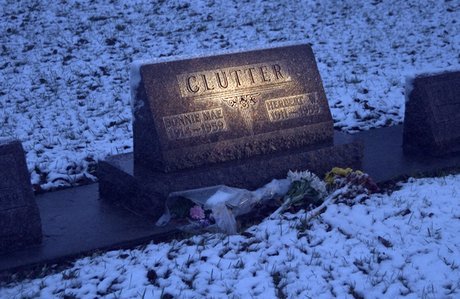
One mid-November night in 1959, four members of the wealthy Clutter family were tied up, shot and killed in their home.  Herb Clutter, a successful rancher, along with his wife and two children Nancy and Kenyon, were found dead the next morning when friends arrived to catch a lift to church.  The book explores how this horrific crime affected the surrounding community, and how the authorities locally and across the US worked tirelessly to catch the culprits.  Alongside events in Kansas, Capote simultaneously offers us the story of the murderers themselves.  Perry Smith and Dick Hickock both had charismatic personalities and complicated back stories, and after the Clutter murders managed to evade the law for over a month and a half before they were finally captured, jailed and taken to trial for their crimes.  They were hanged in April 1965.

So far, so Crimewatch.  What really makes this book special is how much heart and soul Capote pours into it.  His eye for a good story and his focus on people rather than process render In Cold Blood as gripping and enjoyable as a novel.  The amount of painstaking work he must have put into bringing this sweeping story together is genuinely awe-inspiring.  For me, there was also the intriguing fact that Capote was known to have become close to Perry Smith during his research - how much did that skew how he was portrayed?  It was certainly fun to wonder as I was reading. 

Smith and Hickock sit right at the heart of the book, and it is their humanity that provided the most disturbing and thought-provoking aspect of my reading experience.  I found myself reflecting on the complexities of law and order, and the validity of the death penalty.  I began to consider the murderers more closely, to ponder whether one was more guilty than the other and what made them so - their mental health, their level of participation, their attitude?  There were moments where Hickock melted into a normal American boy, and many times where I felt genuine sympathy for Perry and quite liked him - until some little word or gesture reminded me exactly what I was reading and what he had done.

In short, In Cold Blood has everything I want from a book: intriguing characters, an exciting narrative, thought-provoking themes and superb writing.  The fact that the entire book is a work of true crime only adds to its brilliance, because every detail, movement and conversation had to have been so meticulously researched and slotted together to create this perfect piece of storytelling.  I now have the 1967 film adaptation to watch and two more Capote/Hickock/Smith movies to track down (Capote and Infamous) - and In Cold Blood is taking its place as one of my favourite reads of 2012!  Highly recommended.

Notable Quotables:
  • "Imagination... can open any door - turn the key and let terror walk right in.  Tuesday, at dawn, a carload of pheasant hunters from Colorado - strangers, ignorant of the local disaster - were startled by what they saw as they crossed the prairies and passed through Holcomb: windows ablaze, almost every window in almost every house, and, in the brightly lit rooms, fully clothed people, even entire families, who had sat the whole night wide awake, watchful, listening."
  • "'What is life?  It is the flash of a firefly in the night.  It is a breath of a buffalo in the winterime.  It is as the little shadow that runs across the grass and loses itself in the sunset.' - Said by Chief Crowfoot, Blackfoot Indian Chief."


Source:  I borrowed this book from my local library..